


Tag: artist pay

Svenska artister genererade nära 2 miljarder kronor från Spotify under 2025

the text "Loud & Clear" appearing on a black background with arrows

När Spotify grundades för 20 år sedan dominerades musikmarknaden av illegal nedladdning. Sedan dess har streaming bidragit till att återupprätta betalningsviljan för musik och lagt grunden för en starkare och mer hållbar musikekonomi. I dag är musikindustrin större och mer framgångsrik än på länge, både i Sverige och globalt.

Under 2025 genererade svenska artister nära 2 miljarder kronor i royalties från Spotify – nära en fördubbling jämfört med 2018. Samtidigt visar årets siffror flera tydliga trender: fler artister når högre utbetalningsnivåer, närmare hälften av royalties till svenska artister genereras av oberoende artister eller bolag, och 66 procent kommer från lyssnare utanför Sverige. Det understryker både bredden i det svenska musiklivet och den starka internationella efterfrågan på svensk musik.

Detta och mer presenteras i årets svenska Loud & Clear-rapport, Spotifys årliga redovisning av royaltyutbetalningar.

Fler artister når högre utbetalningsnivåer

Fler svenska artister än någonsin når de högre utbetalningsnivåerna. Under 2025 genererade 557 svenska artister royalties på över 500 000 kronor från Spotify, en ökning med 5 % jämfört med föregående år. 301 artister genererade över en miljon (+ 3 %) och antalet artister som genererade mer än 5 miljoner kronor under 2025 på plattformen har nästan fördubblats sedan 2019.

Två tredjedelar av intäkterna kommer från utlandet

Svensk musikexport fortsätter att leverera. Hela 66 % av alla royalties som svenska artister genererade på Spotify under 2025 kom från lyssnare utanför Sverige, en liten ökning från 65 % 2024. Musik framförd på svenska växte med 5 % globalt på plattformen under 2025, och med 11 % sedan 2023.

Jämställt i toppskiktet

En annan tydlig trend i årets data är att Sverige utmärker sig globalt när det gäller representation: bland svenska artister som genererar mer än 1 miljon USD på Spotify är över hälften antingen kvinnliga artister eller band med en mix av kön. Sverige rankas som det ledande landet globalt i denna kategori – ett resultat som speglar att svenska kvinnliga artister når internationell framgång på högsta nivå.

Indiescenen svarar för nära hälften av utbetalningarna

Under 2025 genererades närmare hälften (47 %) av alla svenska royalties av oberoende artister eller bolag, ett tecken på att framgång på Spotify inte förutsätter ett stort skivbolag i ryggen. 

Streaming står för 94 % av marknaden för inspelad musik

Enligt en färsk rapport från IFPI omsatte den svenska marknaden för inspelad musik drygt 2,3 miljarder kronor under 2025. Streaming dominerar fortsatt den svenska musikmarknaden och står för 94 % av det totala marknadsvärdet. 

Spotify är den enda streamingplattform som varje år redovisar hur utbetalningarna ser ut, både globalt och per marknad. Spotifys globala utbetalningar uppgick 2025 till 11 miljarder USD, och sedan lanseringen har bolaget totalt betalat ut närmare 70 miljarder USD till musikindustrin. Läs mer på loudandclear.byspotify.com.

Så fungerar royalties på Spotify

As Spotify Turns 20, the Most Global and Diverse Music Industry in History Has Taken Shape

Let’s turn back the clock 20 years: The music landscape was a world away from the one we know today. Piracy was rampant, revenue was shrinking, and, for most artists, the path to a global career was incredibly narrow. The question on everyone’s mind wasn’t about growth, but whether the industry could survive. It was at that moment that Spotify was founded, to help rebuild a broken system.

Today, the latest edition of Loud & Clear reveals a thriving industry. Our annual report on the economics of music streaming shows the significant growth and structural shifts that have reshaped the business, particularly over the last decade. So what does this new landscape actually look like? The data paints a clear picture of a wider path for artists everywhere to build a sustainable career.

You can explore the full Loud & Clear report on our site, but here are the 10 key takeaways from the data:

1. The $11 billion+ growth engine

For another year, Spotify was the highest-paying retailer globally, paying the music industry more than $11 billion in 2025 and bringing our all-time total to nearly $70 billion. Spotify payouts grew more than 10% year-over-year—more than double the rate of other industry income sources. And once again, roughly half of those royalties were generated by independent artists and labels.

2. The new global class of $100,000 artists

In 2025, more than 13,800 artists generated at least $100,000 from Spotify alone (nearly 1,400 more than the prior year). That’s more artists than were earning half that amount just five years ago.

3. Million-dollar careers

A decade ago, the very top artist on Spotify reached $10 million in annual royalties for the first time. Today, the 80 top artists each generate more than $10 million annually from Spotify alone. 

At the same time, a new class of career artists has emerged, with more than 1,500 artists generating over $1 million in royalties from Spotify last year. In fact, capturing just 1% of streams from 1% of listeners is enough to earn $1 million in annual royalties from Spotify.

4. The rising 100,000th artist

In 2025, the 100,000th-highest-earning artist generated more than $7,300 in royalties from Spotify alone. In 2015, the artist in that same position generated about $350. That’s more than a twentyfold increase in just a decade. In other words, it’s not just the biggest artists making more. It’s massive earnings growth for artists at earlier stages of their careers, too.

5. From Fresh Finds to six figures

More than 1 in 10 artists generating over $100,000 annually on Spotify today were first playlisted within our Fresh Finds ecosystem, which spotlights emerging indie artists. That’s over 1,600 artists featured early by Spotify who have since gone on to build six-figure careers.

6. The DIY path to an enduring career

In 2025, more than a third of artists who generated $10,000 or more in royalties from Spotify were DIY (meaning they self-release their music through independent distributors) or began their careers that way. This path represents a sustained career, as more than 90% of DIY royalties in 2025 went to artists who have been releasing music for more than a year.

7. More than 50% of royalties come from abroad

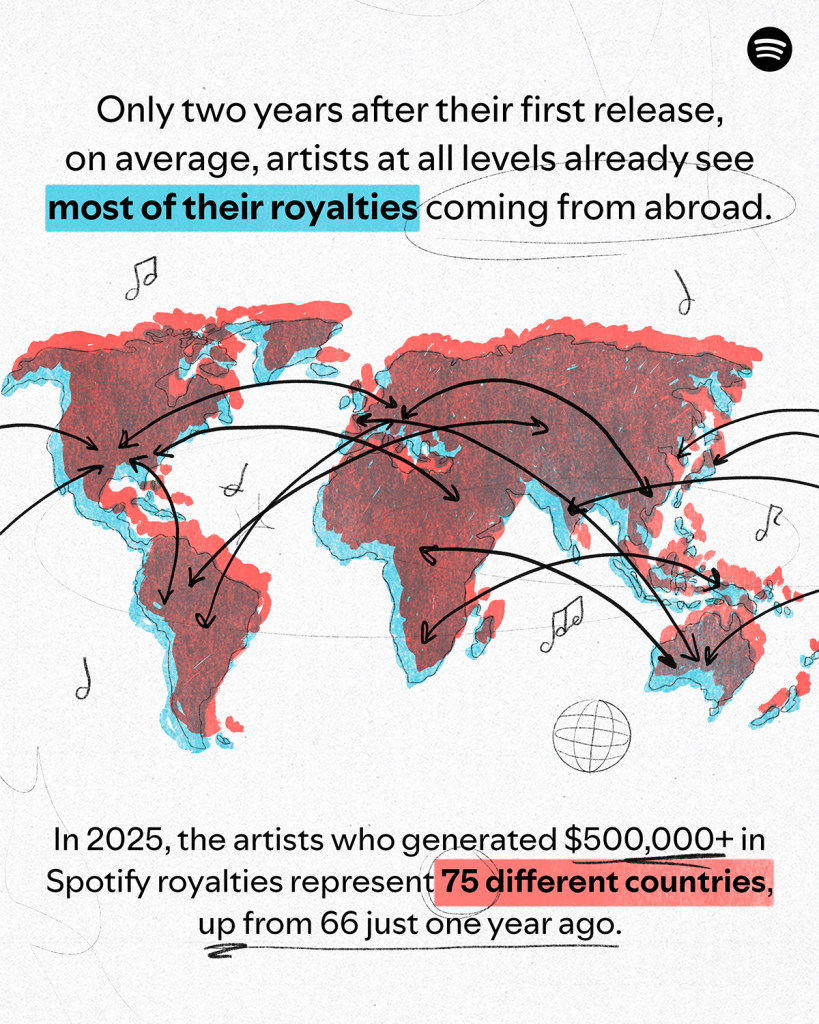
On average, artists see more than half of their royalties coming from outside their home country just two years after debuting. That global listening is lifting artists in more markets to high six-figure earnings levels. In 2025, artists who generated more than $500,000 in Spotify royalties represented 75 countries, up from 66 the year prior. At the $10,000 level, artists from more than 150 countries generated as much on Spotify.

8. Growth speaks many languages

Today’s biggest hits come in more languages than ever. In 2025, songs in 16 languages reached Spotify’s Global Top 50—more than double the number in 2020. Among genres generating over $100 million in Spotify royalties, the fastest-growing were Brazilian funk (+36%), K-Pop (+31%), Latin trap (+29%), Latin urban (+27%), and reggaeton (+24%).

9. Songwriters hit new heights

2025 marked the largest annual music publishing payout in Spotify’s history. Over the past two years alone, Spotify paid approximately $5 billion to the publishers and organizations representing songwriters.

10. More than $1.5 billion in ticket sales

The financial impact of streaming doesn’t stop with royalties, it also powers live music. By the first half of 2025, Spotify had driven $1 billion in gross concert ticket sales for artists. That total has now exceeded $1.5 billion. By connecting real fans with nearby shows, Spotify helps turn everyday listeners into ticket buyers.

A foundation for the future

The music industry is now more global, is more diverse, and supports more artists than at any point in history. The data in this report isn’t just a look back at a record-breaking year; it’s a look at the foundation for a more sustainable future for music. Our work continues, but the goal remains the same: to ensure the path for artists to reach fans and success is even wider tomorrow than it is today.

Head to Loud & Clear to explore the full report.