Tag: gustav

You’re in Control: Spotify Lets You Steer the Algorithm

Spotify bug on a purple background

For the first time, Spotify is giving users the power to steer the algorithm. Gustav Söderström, Spotify’s Co-President, CPO, and CTO, shares the vision behind Prompted Playlists, and how a new era of listener control is taking shape.

Spotify is entering its next chapter, and it felt worth pausing for a moment to look at how far we’ve come and what comes next. With 713 million listeners, 90% of whom say Spotify is essential to their day, we’re standing on the edge of something big. Equally important is our dedication to delivering real innovation and growth for the artists who leverage the power of Spotify to connect with their fans.

That means pushing ourselves again. Stretching the boundaries of what listening can be. And moving into a new era: one that gives you – the user – more control than ever before.

The next evolution of your Spotify

From the start, we’ve tried to make listening feel personal. You’ve seen that in Discover Weekly and Release Radar, which quietly predict what you might love. You’ve also seen it in the tools that let you shape and refresh your own playlists with precision, such as Smart Shuffle, Playlist song suggestions, and Mixing Tools.

But now we’re entering a moment where you don’t just listen to Spotify, you control it.

Imagine a Spotify that doesn’t just passively learn from you but literally listens to you. One you can steer and shape with your own words. For the first time, your ideas, your logic, and your creativity can actually power the Spotify algorithm, directing how it thinks, adapts, and responds to you.

Introducing Prompted Playlist, where your words bring your playlist to life

Starting December 11, Premium listeners in New Zealand will get early access to our latest beta feature: Prompted Playlist. It’s the first feature that puts control of the algorithm and the broader Spotify experience directly in your hands.

Prompted Playlists let you describe exactly what you want to hear and set the rules for your personalized playlist. And unlike anything before it, this feature taps into your entire Spotify listening history, all the way back to day one. Each playlist reflects not only what you love today, but the full arc of your taste. Spotify then curates and keeps it fresh based on your listening patterns and world knowledge.

You could ask for “music from my top artists from the last five years,” then push it further with “and feature deep cuts I haven’t heard yet.” Or you could request “high-energy pop and hip-hop for a 30-minute 5K run that keeps a steady pace before easing into relaxing songs for a cool-down,” and layer on something like “include music from this year’s biggest films and most-talked-about TV shows that match my taste.” You choose how broad or specific you want to go.

You can fine-tune the results by editing the prompt, or start fresh whenever you want. And for each song, we’ll include descriptions and context that tell you the story behind the recommendation so the playlist feels alive and crafted specifically for your prompt and your taste.

You can also set it to refresh daily or weekly so your playlist always stays new and in sync with your world. Consider this your chance to curate your next Discover Weekly, exactly the way you want it. Need a little help getting started? Tap “Ideas” to pick from prompts like “songs from artists who are headlining major tours right now,” and get a playlist tailored to your taste.

For even more inspiration, our music editors and culture experts have crafted a set of fun and inventive prompts and English language algorithms that will show up as personalized playlists on Home. And because this is a beta, the experience will evolve as we scale to more listeners. We’re excited to see what we learn along the way.

Why it matters

We believe that technology is only as good as the humans behind it. Spotify listeners have created nearly 9 billion playlists, which is proof that human curation is still the heartbeat of the platform. But until now, unless you were a developer at Spotify and could write your own playlist algorithm, your best ideas might have stayed in your head.

Prompted Playlist brings those ideas to life using just the English language. There’s no longer a tradeoff between control and convenience. You finally get both.

And for artists, this unlocks smarter, more inspired discovery, surfacing their music for the right listeners and opening new ways to deepen their fan bases. 

What’s next: More control for you

This new feature is part of a broader shift in how we think about personalization and what we think consumers will expect from their services in the future. Our goal is to make Spotify more personal, more responsive, more intelligent, and more aware of the world and culture around it, in order to bring greater value to listeners, artists, and creators.

This is just the beginning of a new phase where listeners take the lead and make even more of every minute.

2026 is going to be epic for fans and artists alike. We can’t wait to share what’s coming next. Stay tuned.

Spotify’s Next Step on Our Path to Net Zero Emissions

Technology is all about interlocking systems that work together efficiently, and we often think about iterating on these systems to make them better. Climate change is one of these interconnected issues—making it vitally important for companies to disrupt old systems when it comes to combating the effects of global warming. That’s why, in September 2021, Spotify joined the Exponential Roadmap Initiative and the UN Race to Zero, a first step on our more ambitious climate action journey. 

The Exponential Roadmap Initiative consists of a network of selected innovative companies, scientists, and NGOs that commit to exponentially reducing greenhouse gas emissions,  educating and inspiring others to do so though their platforms and businesses, and engaging with the wider community to push the climate action agenda forward. 

“Climate change is one of the most pressing global issues of our lifetime,” says Gustav Söderström, Spotify’s Chief R&D Officer. “Spotify has a responsibility to combat the effects of climate change, which is why we’re aiming to reach net zero emissions within the next decade.” 

Over the next days, months, and years, we’ll look to disrupt our ways of working and curb our emissions over a variety of ways:

  • Making our workplaces better: We continue to redesign, remodel, and run our offices with an eye toward environmental efficiency, accessibility, and renewable solutions.
  • Stream green: A percentage of our emissions is generated by streaming, downloads, and device battery usage. We are measuring this impact and aim to generate lower energy consumption from different devices, while offsetting any remaining emissions.
  • Partnering with suppliers who share our goals: Our biggest source of emissions is the goods and services we purchase. We are focused on collaborating with like-minded suppliers to reduce emissions in this area.

“We are delighted that Spotify joins other front-runners in climate action within the Exponential Roadmap Initiative,” says Johan Falk, Head of Exponential Roadmap Initiative and lead author of the “Exponential Roadmap and the 1.5°C Business Playbook.” “Spotify has a unique reach and opportunity to inspire people around the globe to take climate action.”

We’re already on our way to create climate-conscious solutions and use our platform to spread awareness and amplify action. Our Sustainable Sonics provide a low-carbon alternative to other forms of advertising. Our curated podcast playlists and Climate Action hub provide important information on taking climate action for our listeners. And finally, check out the Life at Spotify website climate section for the latest actions and reports. 

But there’s so much more to be done, and we need to do it now. Joining the Exponential Roadmap Initiative demonstrates our commitment to taking action, and we look forward to collaborating with our partners, incorporating feedback, and sharing more updates on this crucial journey.

Looking to learn more about the Exponential Roadmap and greenhouse gas-reducing solutions? Stream “The Scientific Case for The Race to Zero with Johan Rockström” or “Nigel Topping Racing to Zero.”


Forward-Looking Statements

We would like to caution you that certain of the above statements represent “forward-looking statements” as defined in Section 27A of the United States Securities Act of 1933, as amended, and Section 21E of the United States Securities Exchange Act of 1934, as amended. The words “will,” “aim,” and similar words are intended to identify forward-looking statements. Examples of forward-looking statements include, but are not limited to, statements regarding our net zero emissions target, the anticipated timing of achieving such target, and the actions we plan to take to curb emissions and push the climate action agenda forward. We intend such forward-looking statements to be covered by the safe harbor provisions for forward-looking statements contained in the Private Securities Litigation Reform Act of 1995 and include this statement for purposes of complying with the safe harbor provisions. Such forward-looking statements involve significant risks, uncertainties and assumptions that could cause actual results to differ materially from our historical experience and our present expectations or projections, including but not limited to the risks as set forth in our filings with the United States Securities and Exchange Commission. We undertake no obligation to update forward-looking statements to reflect events or circumstances occurring after the date hereof.

Daniel Ek, Dawn Ostroff, and Sten Garmark Shed Light on the Insights That Led Spotify Into the Podcast Arena

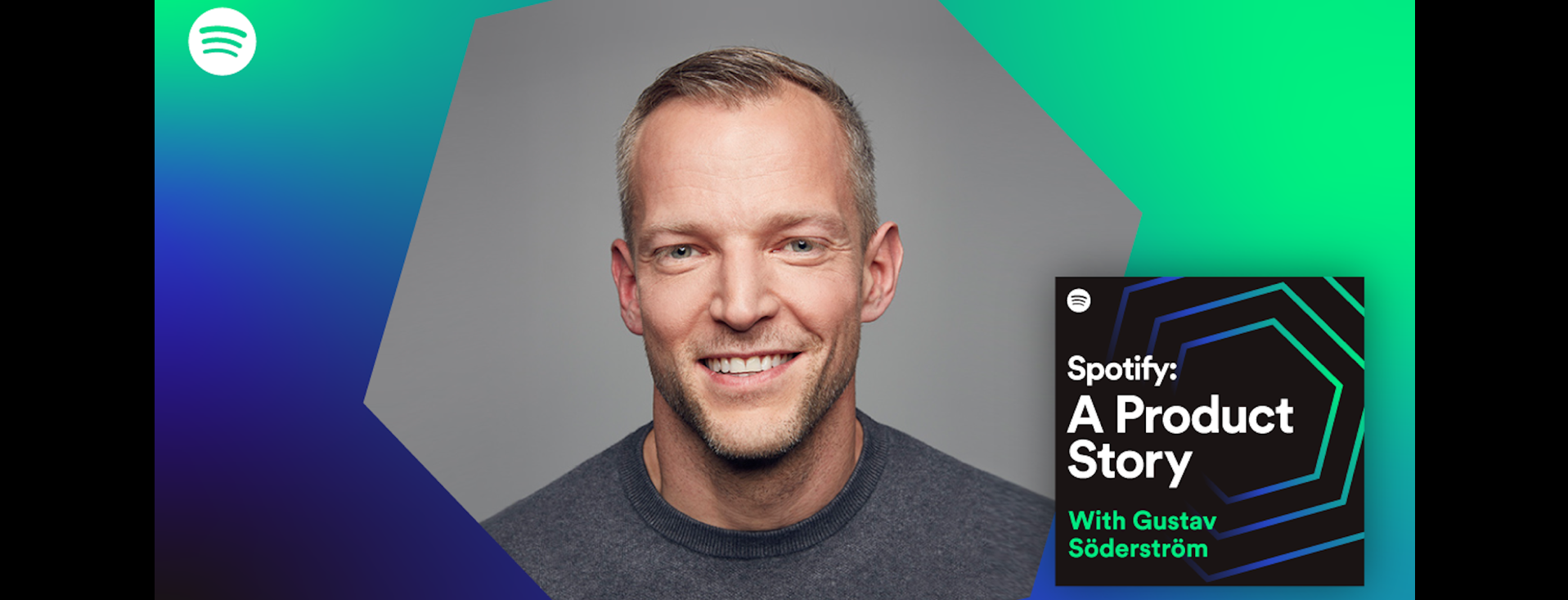
Did you know that Spotify could have been a video company? This is just the latest revelation from Spotify cofounder and CEO Daniel Ek in our Chief R&D Officer Gustav Söderström’s podcast, Spotify: A Product Story. The miniseries brings listeners insider stories of product strategy and development at Spotify as told by the people who built it. 

In the most recent episode, Gustav talks about Spotify’s search for its “first second product” with Daniel. And for a moment, that product could have been TV. But thanks to internal experiments during Hack Week, as well as the realization that listeners in Germany were using the platform to play audiobooks (uploaded as music tracks) the team realized there was a better opportunity: spoken-word content.

“There were so many signals that pointed out that this was the right thing,” shares Daniel. “And then, ultimately, if we could do this and if we could merge podcasts with music and basically get into audio, we would be in a much better place strategically . . . It was clear there wasn’t anyone globally going after this opportunity, and that opportunity is massive.”

So began Spotify’s shift to an audio-first strategy in 2019

“We felt that one of the big things that we could do was accelerate podcast growth,” shares Sten Garmark, Spotify’s Head of Consumer Experience, who is a guest on the episode. “This is a fantastic medium that has seen a lot of growth, but it’s not a true mainstream product yet—it wasn’t when we started and it’s arguably still not.”

Dawn Ostroff, our Chief Content Officer, joins Gustav on the podcast to talk about developing original content to lead the audio space and accelerating podcast growth in the process. “Everybody appreciated the fact that we could put our own imprimatur on an industry, that we could lead the entire medium,” explains Dawn. “The industry had been so fragmented, and [before Spotify], nobody had stepped in to really aggregate the business from either a creative stance or from the business stance or from the advertising point of view.”

Follow along as Gustav and his guests recount the journey and share four key product strategy lessons Spotify learned along the way.