Tag: brazil

Pop Star Pabllo Vittar Gives Voice to Brazil’s LGBTQ Community

On Saturday evening in early November, 10,000 Brazilians gathered at the Hopi Hari amusement park just outside São Paulo and held their lighters aloft. It was Pride Day, and the celebrants were there to see Pabllo Vittar, one of the country’s biggest pop stars and the most famous member of its LGBTQ+ community. Amidst cheers from her fans, whom she lovingly refers to as Vittarlovers, she commanded the stage, powering through her anti-bullying anthem “Indestrutível.” The song is a paean to resilience, a tribute to Vittar’s own well-known struggle against homophobic harassment as a teen.

Onstage at Hopi Hari, Vittar stood a regal six feet, one inch in flats, her long blonde hair slicked back behind her ears; she looked like a video game character who comes in peace, but will defend herself if the situation calls for it. “If I receive pain, I give you my love,” she sang to the audience, who mouthed every word. “And the more pain I get, the more I realize that I am indestructible.” The ballad concluded as Vittar raised her fist, leading her Vittarlovers in a familiar chant: “Eu resisto, Eu resisto.” I resist. I resist.

A Voice for Brazil’s LGBTQ Community

Vittar welcomes me with a hug. She is friendly and engaging—laughing easily and often. She is one week into the tour in support of her second LP and wants to talk about the positives.

“I feel great!” she says as we begin our conversation. “I feel full of energy. We have a whole new show, new album. It’s like I’m giving birth. I’m euphoric!”

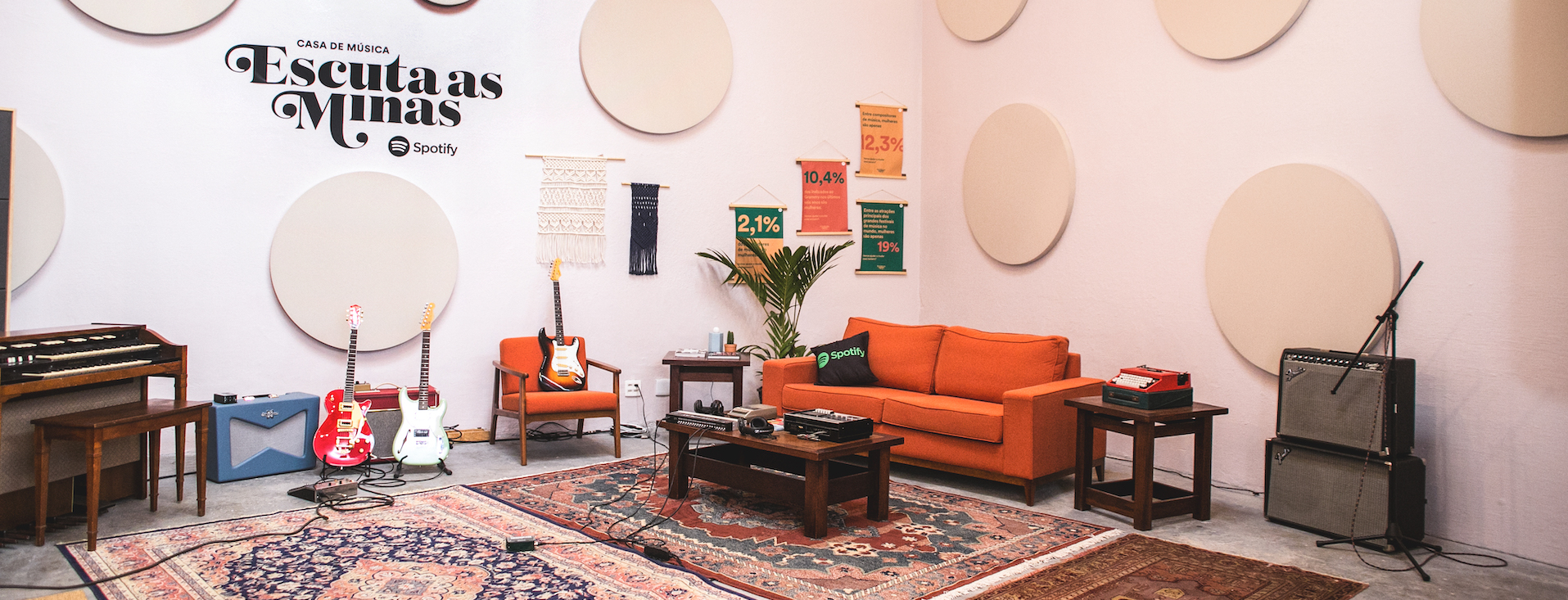
Spotify Celebrates the Brazilian Fight for Equality with Escuta as Minas (Listen to Women)

Brazilian women are no strangers to the protest song. From Elis Regina’s 1970s cryptic opposition to class inequality in “Arrastão” to Valesca’s 2012 LGBTQ equality and female sexuality anthem “Sou Gay,” the movements of the nation are echoed in its music. Today, the Brazilian Women’s Movement is stronger than ever—and its followers continue to proudly raise their voices against workplace harassment, gender violence, income inequality and, now, their places in the music world.

Spotify creates initiatives to increase diversity and amplify female voices all over the world, from Equalizer in Sweden to Sound Up Bootcamp for women of color in the U.S., UK, and Australia. Now, we’re inspiring our Brazilian audiences to get on board. By joining with several talented Brazilian female artists, we’re turning up their volume and creating an important initiative for lovers of Brazilian music: Escuta as Minas (Listen to Women).

“In every generation in Brazil, women have persevered,” says Gabriela Lancellotti, Spotify Head of Consumer Marketing for Brazil. “Despite hardship and setbacks, we put our best foot forward and sing through the pain. ‘Escuta as Minas’ is an opportunity to recognize that idea while empowering the young people listening to continue to work for full equality in music and in everything we do.”

Statistics show that the music world both in Brazil and globally continues to be male dominated. A study by the Annenberg Inclusion Initiative revealed that 2017 marked a six-year low for female artists in popular content, with women comprising only 16.8 percent of artists. Out of the study’s 651 producers, just 2 percent were female. And of the 899 individuals who were nominated for a Grammy Award between 2013 and 2018, only 9.3 percent were women.

That’s why our campaign, featuring an original song, music video, and documentary, highlights a diverse group of 11 inspirational female Brazilian artists who span the ages—along with their songs, stories, and messages. Our mix includes Cássia Eller, a ’90s Brazilian rock icon, Karol Conká, a contemporary feminist rapper who is breaking barriers and fighting stereotypes, and other established and rising Brazilian stars—Elza Soares,Maiara & Maraisa, MULAMBA, and Mart’nália. Plus, three chosen artists depict female Brazilian music idols from the past: As Bahias e a Cozinha Mineira, Tiê, and Lan Lanh as Chiquinha Gonzaga (1847-1935), Maysa (1936-1977) and Cassia Eller (1962-2001), respectively.

The project was created in a joint effort with the media agency CUBOCC and production company A9 out of existing lyrics from decades of influential female Brazilians who fought for their own space in the world. Inspiring words that symbolize the ongoing fight that has spanned generations include:

“Ó abre alas que eu quero passer.” – “Oh make way, I want to go through.”

“O meu país é meu lugar de fala.” – “My country is my place of speech.”

“Seja o que tiver que ser, seja o que quiser.” – “Be what you need to be, be what you want to be.”

We’ve created a short film about the ongoing quest for women’s equality. At the core of the film is a music video for the original song, which will premiere in theaters, on Smartv, and on the internet in Brazil, as well as live on the Escuta as Minas site (along with English subtitles). The video depicts each artist as a woman from a particular time period to represent the idea that the struggle to be heard is something of many generations.

Want to learn more? Each singer is also featured in a mini documentary on our Escuta as Minas hub in which they share testimonials about their careers, visions, opinions of feminism, and experiences in the industry.

As the film says, “The fight goes on: For more women in music, for more women being heard.”

Straight Out of the Favela: Brazilian Funk

If you haven’t heard of Brazilian funk (or Baile Funk) yet, you will soon. Pumping hard from the heart of Rio de Janeiro, the genre derived from Miami bass and gangsta rap is blowing up across the world. With its infectious looping tamborzão rhythms and raw party anthem lyrics, Brazilian funk is twerking its way to the top of the charts. (After all, twerking is basically the unofficial dance of the genre.) And a rising new generation of funkeiros—AnittaMC KevinhoMC Fioti, and Ludmilla among them—are fueling the movement.

Brazilian funk star Anitta (née Larissa de Macedo Machado), who became a breakout sensation after singing in her home city of Rio at the 2016 Olympic Games, is catapulting the Miami bass and gangsta rap-rooted Afro-Brazilian genre into the global spotlight on Spotify.

Last December, just 12 hours after releasing “Vai Malandra” (feat. Tropkillaz & DJ Yuri Martins), the silky-voiced singer laid claim to the first Portuguese-language song to land on Spotify’s Global Top 50 chart.

“It’s a great time for Brazilian funk music because we have some great artists investing in it and producing great hits with funk beats,” Anitta said. “Tropkillaz, Major Lazer, me and many other artists are helping making this moment even hotter. A good example is MC Fioti’s song, “Bum Bum Tam Tam,” that exploded on Spotify. He even made a collab with J Balvin after that. It makes me really happy to see funk getting recognition worldwide.”

Empowered by the unparalleled freedom and exponential reach of digital music online, outspoken female Brazilian carioca artists like Anitta—along with protest rapper Karol Conka, feminist icon Valesca Popozuda, 18-year-old São Paulo prodigy MC Rita, and a growing wave of trailblazers like them—have been leading the way toward globalizing the genre. Anitta joins an eclectic cadre of bold voices including Ludmilla, MC Loma e As Gêmeas Lacração—and the list goes on.

“Seeing the explosion of Brazilian baile funk gives me the feeling that we are doing our role well as a label and in media, but at the same time it proves that this is the tip of the iceberg, which can be much larger and explore other territories,” says Brazilian music video director and producer Kondzilla. “Baile Funk as a genre is lively and contagious. The music industry is already watching.”

See for yourself just how quickly this viral music genre has spread like wildfire across the world from 2016 to 2018.

Music experts around the world are being wowed by this growth. “Brazilian funk is a true world phenomenon,” said Roberta Pate, Spotify’s Artists & Label Services Manager for Latin America and US Latin Markets. “In the last two years, the genre has broken the barriers and boundaries of Rio de Janeiro’s favelas, and Brazil, to win the world. It’s now one of the most heard genres in Europe, North America and Central America.”

One Funk producer can release up to 100 original songs per month, and with every bass-bumpin’ beat streamed, the democratizing power of the Internet rapidly catalyzed the spread of already speedily produced funk far beyond Brazil’s favelas and onto a worldwide stage.

“Spotify and the Internet are great instruments for spreading good music around,” said Anitta. “It’s powerful, simple and fast, and it makes things easier for different artists to show their songs with Spotify.”

“The great partner of artists like Anitta, MC Kevinho, MC Fióti and Ludmilla, is the Internet, more precisely Spotify and music streaming services, which allowed this phenomenon to expand outside Brazil,” Pate said. “Proof of this success away from home and its internationalization, funk has a playlist focused on international users on Spotify, called Mother Funk.”

“Mother Funk,” the Brazilian funk-filled Spotify playlist, tells the history of funk, with greatest hits from the 80’s until today. It’s especially popular in the United States, Portugal, Argentina, Paraguay and Mexico. To hear what all the buzz is about—top songs from Anitta, Dani RussoMC Kevinho and DJ Malboro included—check it out here.