

Tag: pride

Spotify’s Progress Toward Racial Equity: Reflections, Commitments, and Updates for the Year Ahead From Elizabeth Nieto and Spotify’s Equity and Impact Team

Each year, as Spotify celebrates Black History Month, we are offered an opportunity to take stock of how we are doing as a company when it comes to our work in the pursuit of racial equity. This February marks my first as Spotify’s Global Head of Equity & Impact, and it comes at a time when the company has faced new challenges as we learn and grow and the landscape evolves around us.

Making real and sustained progress has never been easy. Spotify understands the need for hard work, true reflection, and real accountability and we view our anti-racism efforts as an ongoing journey as we strive to live our values, both internally and externally. We are committed to fighting systemic racism and doubling down as this work advances. And while we still have plenty to do, we are making progress. That’s why, at each step of the way, we are looking to partners, employees, and creators to help guide our actions for the long term. 

We also understand the need to regularly communicate the progress we’ve made and identify actions that will build upon it in the years ahead. As we close out Black History Month in the U.S., we recognize the need to do more to combat racism around the world. 

So today, members of the Equity and Impact team—that’s me, Elizabeth Nieto, alongside Travis Robinson, Global Head of Diversity, Inclusion & Belonging, and Christopher Kenny, Diversity, Inclusion & Belonging Lead, Racial Equity Strategy—are sharing updates of both work we’ve done and work that’s underway across our global markets in the pursuit of racial equity. 

This is but a snapshot of our focus areas in our ongoing commitment to fostering an anti-racist culture at Spotify. And while we know we are not perfect, we remain unwavering in our approach and commitment to making meaningful change and progress as a company. 

With gratitude,

Elizabeth, Travis, and Christopher 

Deepening dynamic relationships with racial equity partners

We continue to collaborate with our external racial equity partners to inform how we can best leverage our brand and platform to mitigate systemic racism. Those conversations will inform our strategies for the year ahead and beyond. As one example, we support the healing and growth of our Spotify community through our partnership with Brooklyn Minds, a mental health organization. Brooklyn Minds facilitates sessions for employees who’ve been impacted by racial trauma. We also provide individualized support through our employee assistance program.

Focusing on giving to organizations with measured impact for the Black community

As we shared last April, Spotify’s Racial Equity Donations & Giving Program has committed $10 million—including the matching of $3 million from Spotify employee donations around the world—to over 300 organizations. The remaining $7 million has been donated to more than 15 organizations dedicated to inspiring, connecting, and elevating the next generation of Black voices and creators. This will be an annual commitment through our Racial Equity Donations & Giving Program. We also recently announced the creation of 28 scholarships to Black HBCU students, in partnership with UNCF (the United Negro College Fund).

Formalizing Spotify’s Creator Investment Fund

Over the last several years, Spotifiers have built initiatives to identify, support, nurture, amplify, and celebrate the many voices of creators who deserve to be heard. Much more must be done to further this existing body of work, which is where our recently announced $100 Million Creator Investment Fund comes in. It’s important that we continue to create new avenues of support to champion artists, songwriters, and podcast creators from diverse backgrounds. Spotify can help them build their own businesses by establishing passionate fan bases and substantially growing their reach.

There’s great excitement for this work, with many ideas and questions about next steps we must take. While it’s critical to move swiftly, we also understand it will take time to get this work right. Spotifiers from teams including Music, Podcasting, and Equity & Impact are co-developing plans and working closely alongside our creator and industry partners for input. We’ll share early plans with our ERGs (employee resource groups) for their input and further refinement.

We have identified an initial list of the existing programs and opportunities where we think these funds can be put to work quickly, including adding incremental support to the ongoing work of Frequency, Sound Up, EQUAL, and Pride, among others. Additionally, we will dedicate talent and resources to help lead this global effort. We will work with internal teams and outside organizations to establish new programs focused on areas such as studio space, creator tools, marketing and PR support, coaching, and mentorship.

Expanding and scaling our current Black creator and consumer engagement brands

Last May, when Spotify launched Frequency—our global initiative and holistic destination for celebrating Black art, entertainment, creativity, culture, and community both on- and off-platform—we did so with a mission to create a space that represents the wide spectrum of Black artistry. Since then, listeners have tuned into Frequency music playlists like Ripple Effect and House Party and learned from the Heard You podcast playlist. We’re committed to celebrating and uplifting Black culture, creativity, and community year-round, with special emphasis on the month of February in honor of Black History Month in the U.S. This year, we’ve created a space to celebrate the multidimensionality of Black listeners, artists, and creators to truly encompass the breadth of Black creativity. 

We recognize the need to do a better job of cascading these stories to a broader audience and will continue to scale our approach to our work of promoting Black stories and experiences. For example, we’ll amplify the great Black creators who are sharing stories that resonate with the community, like the Spotify original Who We Be TALKS_ from the U.K.

2020 Equity & Impact Report and 2021 restructuring

Our 2020 Sustainability, Equity & Impact Report charted the meaningful progress we’ve made through our cross-functional Spotify Racial Equity Coalition, alignment to our BLK 5-Star strategy, and expansion of the work of Diversity, Inclusion & Belonging in a variety of ways. But it was only a first step in measuring our work and impact.

So in 2021 we restructured our organization to bring together three existing teams: Social Impact; Diversity, Inclusion and Belonging; and Sustainability. We did this because we believe in the power of our people, their stories, and the impact we have as a platform to imagine and deliver a sustainable future that is welcoming for all in a world that’s centered on justice, equity, and environmental sustainability. We’re seeing greater synergy and collaboration as a unified approach across our three groups. The cohesion of the team is reflected in our Sustainability, Equity & Impact report. 

Continuing anti-racism education and inclusive storytelling training internally

We launched inclusive storytelling training and education within Spotify’s Marketing, Music, and Podcasting Creator teams in 2021 and continue to conduct key diversity, equity, and inclusion  sessions monthly. Within our Studios organization, efforts are underway to establish greater creator representation and also partner with anti-racism practitioners to train and educate all employees. We plan to relaunch our formal anti-racism training for employees this year.

Expanding our focus on inclusive hiring and workforce development

While we have seen progress in our Black employee representation in the U.S. over the last four years (3.7% in 2017 to 9% by end of 2021), we are working on driving the same level of advancement toward diverse representation in our leadership ranks. In late 2021, we launched an inclusive hiring training course for all interviewers and hiring teams. Topics covered within this training are associated with anti-racism, microaggressions, bias, and other relevant diversity, equity, and inclusion conversations. In deep partnership with our Talent Acquisition team, the Inclusive Hiring team has also curated related sourcing and diversity recruiting partnerships that focus on greater visibility and identifying better ways of attracting talent to Spotify from underrepresented communities.

In 2022, we’ve been working hard to expand our inclusive hiring goals for racial diversity in the U.S. but have also begun the process of identifying areas of improvement in ethnic diversity in key markets globally. For instance, we are working to identify greater ways to increase Black, Asian and minority ethnic representation in our U.K. workforce. We will launch a workforce development conference for our Black Spotifiers across EMEA. In addition, in a few weeks we will launch our first-ever Global Belonging Week for all Spotifiers. This will feature global diversity, equity, and inclusion content, training and education for all band members to learn and also provide for localized “pass the mic” sessions where employees in specific offices will discuss topics such as anti-racism, intersectionality, and meaningful change.
LGBTQIA+ Spotify Employees Share How They Claim Their Space

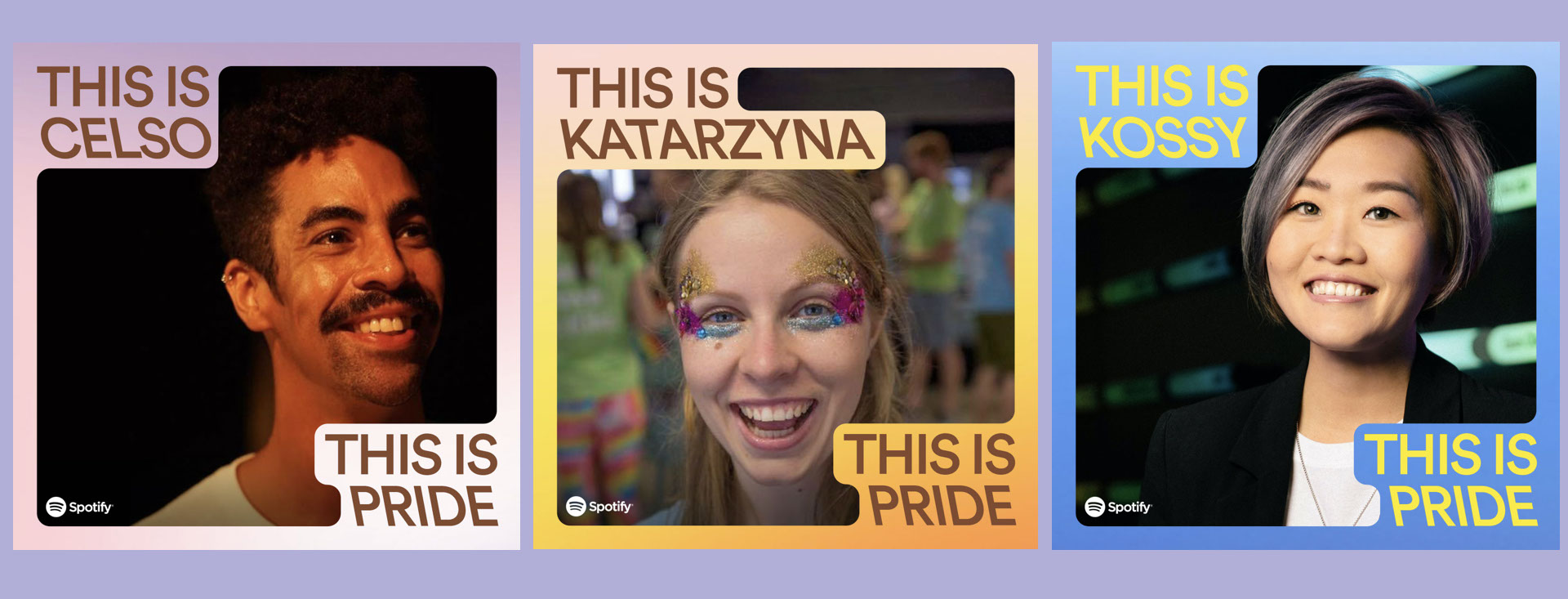
Spotify kicked off June by announcing this year’s Pride campaign, CLAIM YOUR SPACE. The experience, complete with playlists, podcasts, and permanent in-person murals, served to celebrate the commitment and resilience of LGBTQIA+ creators. It also recognized the ways audio and art have always been avenues for LGBTQIA+ expression. We encouraged the queer community of creators and listeners to continue to make noise, make their presence known, and make their own rules. 

We also used Pride Month as a time to encourage, empower, and amplify the voices of LGBTQIA+ Spotifiers within our own community. So as Pride Month comes to a close, our Life at Spotify social channels shared how several queer employees “claim their space” in the workplace, as well as the songs and aritsts that help them live their identities loud and proud. 

Jordan (he/him)

Spotify Presenta ‘Coming Out: Emociones Compartidas’, un Podcast Original con Inspiradoras Historias de Creadores LGBTQIA+

Para Spotify, Pride se trata de crear un espacio permanente para las personas LGBTQIA + y sus historias, y brindar la oportunidad de un sentido de pertenencia que es tan fundamental en el proceso de salir del closet. En el nuevo podcast  original de Spotify Coming Out: Emociones Compartidas, nos propusimos encontrar creadores icónicos de la comunidad para preguntarles sobre su historia, experiencias y lecciones de resiliencia.

Coming Out fue lanzado originalmente en Francia. Ahora, en su nueva temporada en México presenta las historias de invitados como Christian Chávez, Raymix, La Bruja de Texcoco, artista RADAR México, y la periodista de deportes Marion Reimers, entre otros. 

Estas son algunas de las historias íntimas que los oyentes podrán descubrir exclusivamente en Spotify durante el mes de junio.

El actor y cantante Christian Chavez es conocido por millones de fanáticos por ser parte del fenómeno pop RBD. Y aunque muchos de ellos conocen su dura experiencia de salir del closet, nunca habían escuchado su historia tan personalmente. En el primer episodio de la serie, Christian cuenta su difícil momento en una escuela católica donde sufrió bullying, ofrece un relato gráfico de su primer beso y comparte su primera visita a un club gay. También describe su experiencia pública al salir del closet después de ser extorsionado por un tabloide en marzo de 2007.

“Escribí un comunicado llorando y ni siquiera podía escribir la palabra ‘gay’”, comparte en el episodio. “Al día siguiente hubo aplausos y expresiones de apoyo, aunque gran parte de la prensa fue hipócrita porque luego los medios se volvieron en mi contra para escribir historias sensacionalistas. “

Luego que se cancelaran varios proyectos por discriminación, Christian decidió retomar su carrera como solista y escribió Libertad, una canción que trata sobre ser uno mismo. 

Marion Reimers es una exitosa narradora y comentarista y la voz en el podcast original de Spotify Fútbol a Muerte.  En su episodio en Coming Out habla del periodismo deportivo como un espacio homofóbico, machista y patriarcal al que le costó demasiado tiempo incluir a una mujer lesbiana en sus filas. Desde niña sintió la urgencia de desafiar a la heteronorma y siempre prefirió jugar a los piratas que a la casita.

“Estoy muy orgullosa de quien soy”, cuenta Marion en su episodio. “La deconstrucción de normas sociales es un trabajo de todos los días, es muy pesado porque vivimos en una sociedad que nos enseñó a avergonzarnos y hay quien sigue usando este discurso para descalificarme. Yo me siento fuerte, tengo un entorno de amistades, de familia y compañeros en el trabajo que me han ayudado. No lo haces solo, lo haces a través de la comunidad. ”

Fabian Chairez es un artista plástico mexicano. Gran parte de su obra es un cuestionamiento a la masculinidad tóxica. Salto a la fama mainstream por su obra Revolución que muestra a un Emiliano Zapata en tacones y encima de un caballo blanco. La obra provocó un escándalo en grupos conservadores que entraron al Palacio de Bellas Artes decididos a prenderle fuego. Fueron detenidos por personal del museo, muchos de ellos LGBT+. 

“Me mostraron la imagen cuando estaban golpeando a uno de ellos y de inmediato me llevó a ese momento en Chiapas cuando dos hombres me amenazaron con un cuchillo solo porque iba de la mano con mi novio. Y dije no, eso no puede volver a pasar. Si quieren pelear, aquí estoy. Empecé a dar entrevistas y hacer presente mi voz.”

Ana Julia Yeyé es comediante de stand-up y quizá por eso su salida del clóset es la más divertida del podcast. Cuenta la vez que salió con una chica con la intención de demostrarle que no era lesbiana y terminó por darse cuenta de justo lo contrario. Su primer beso logró que todas las piezas de su vida terminaran de encajar. 

No hay fuerza más poderosa para cambiar mentes y corazones que el poder contar nuestras historias. Por eso Spotify se unió a It Gets Better México para ofrecer ayuda a jóvenes LGBT+ en temas de salud mental, sexual o grupos de apoyo. 

Descubre las historias de creadores LGBTQIA+ y escucha Coming Out: Emociones compartidas a continuación.

This Pride, Spotify Encourages LGBTQIA+ Creators to CLAIM YOUR SPACE

Throughout their lives, LGBTQIA+ creators, cultural figures, and activists have fearlessly demanded to be seen, heard, and recognized as who they authentically are. They’ve carved out space for themselves and their communities to thrive, ultimately creating a richer, more vibrant world. This year, Spotify’s Pride campaign is a celebration of that commitment and resilience, and a recognition of the ways audio and art have always been avenues for LGBTQIA+ expression.

This Pride, Spotify is encouraging the queer community to make noise, make their presence known, and make their own rules with a single rallying cry: CLAIM YOUR SPACE. With a series of activations, this global campaign is aimed at creating permanent space, both physical and digital, for the LGTBQIA+ community. 

For too long, there have been glaring gaps in the traditional historiography of music, gaps that often served to minimize or completely erase LGBTQIA+ creators’ indispensable contributions to the development of entire music genres and modern audio culture as a whole. And so, for this year’s Pride, we focused on harnessing the full power of our platform to highlight iconic as well as more emerging queer artists and podcasters, asserting this community’s rightful place within the canon and within the culture. 

Today, we’re kicking off a full month of on- and off-platform programming. Make sure to check out: 

Spotify Celebrates LGBTQIA+ Creators and Fans With Our 2020 Pride Campaign

Let’s face it: Pride looks a little different this year, with cities around the world unable to host celebrations in honor of LGBTQIA+ community, representation, and progress. But although queer folks and allies can’t take to the streets with flags, floats, and festivals this summer, we can all celebrate the feelings of pride and togetherness that come from streaming LGBTQIA+ artists and creators.

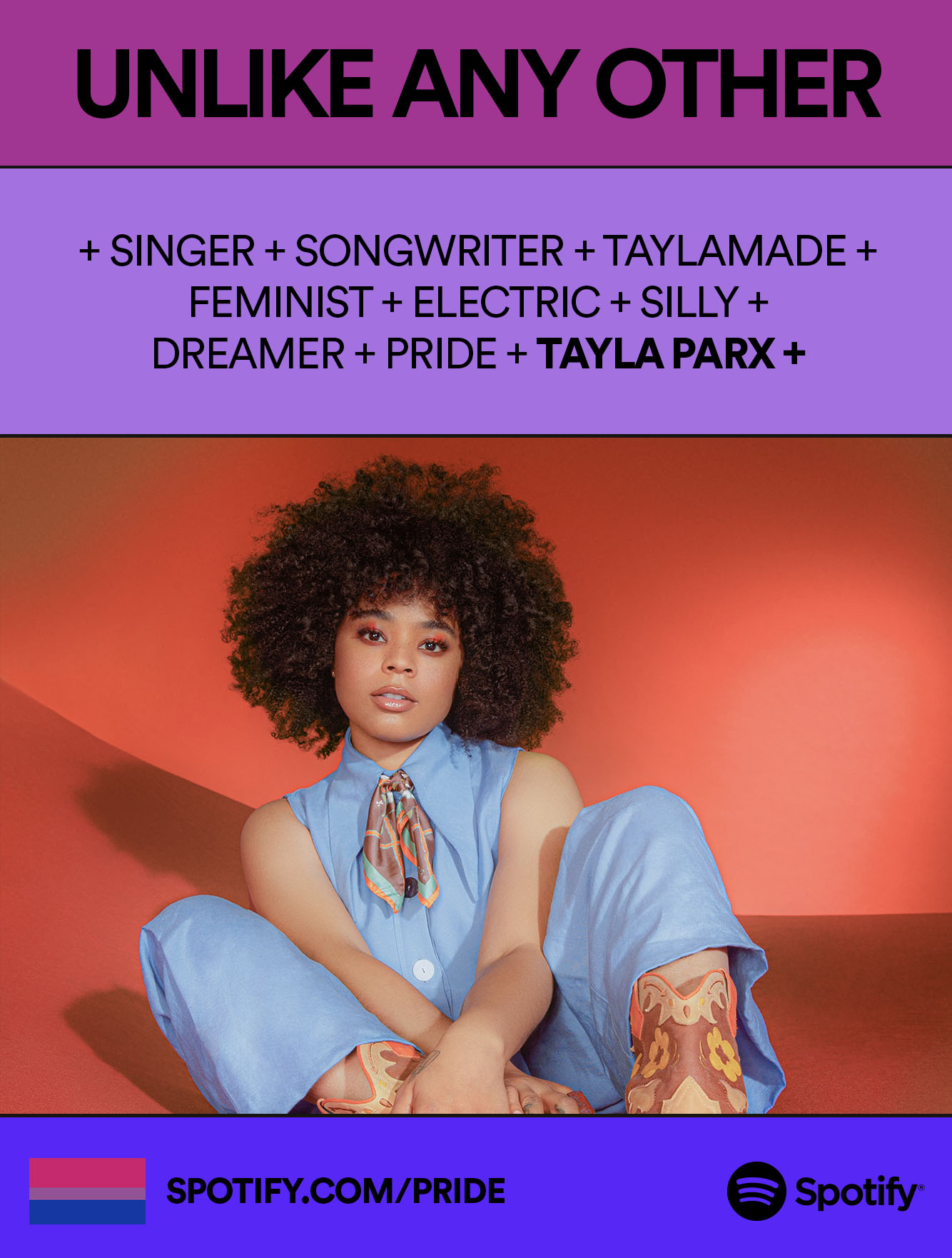
Spotify has the unique ability to inspire and drive positive change through the power of audio. At this time, we know that feelings of togetherness and shared experiences have never been more important, which is why today we’re unveiling Unlike Any Other—Spotify’s 2020 global Pride campaign celebrating LGBTQIA+ creators and connecting them to fans around the world.

 Unlike Any Other is all about empowering LGBTQIA+ creators to embrace their uniqueness and connect to new and existing audiences through the power of music and podcasts. The Unlike Any Other marketing campaign, which will live in 38 countries where Pride is celebrated, includes a key element—the Progress Flag—designed by Daniel Quasar in 2018. The Progress Flag adds five stripes to the traditional rainbow Pride flag to better include trans and non-binary individuals, marginalized communities of color, those we have lost to AIDS, and those living with HIV today within queer representation.

Plus, our Pride 2020 campaign features new content and experiences on platform, all available in the Amplify: Pride hub on Spotify. Each playlist, song, and podcast is as unique as the individual who created it—which means there’s a little something for everyone. Check out what’s available within the Amplify: Pride hub.  

The House of… Ballroom Playlists

From Kiki to Pose and now Legendary, the house and ballroom community has made a lasting mark on modern pop culture. This playlist series, in partnership with Pose runway choreographer Twiggy Pucci Garcon, celebrates the iconic movement with curated playlists by top figures of ballroom culture, including Jason Ozzie Ash, Byrell The Great, Jack Mizrahi Gucci, and Jonovia Chase.

Pride-Themed Playlists

The hub will include a variety of curated Pride-themed playlists for every listener, such as Pride Classics, Latin Pride, Alternative Pride, Queer as Folk, Disco Fever, queer-themed Cosmic playlists and more. Additionally, our flagship queer playlist Out Now: Unlike Any Other further emphasizes the dynamism of emerging and established queer voices in music. 

Astrologer Chani Nicholas Is Back with Horoscopes that Celebrate Pride

In January, we interviewed astrologer and activist Chani Nicholas when she debuted her Cosmic Playlists on our U.S. Pop Culture Hub. Now, she’s back for Pride Month with new, specially curated playlists that speak directly to pride, identity, representation, and love.

We circled back with Chani to get her take on why horoscopes resonate with the LGBTQ community. Much like her insightful horoscopes, the answers speak for themselves.

For those unfamiliar with horoscopes, why do you think they resonate so much these days? Particularly with millennials and Gen Zers?

Astrology holds up a mirror to who we are as people. It affirms us and calls us out. We need both. Life today is so unpredictable, and we all crave some system that contextualizes the difficulties we face, both personally and collectively—which is what astrology naturally does.

Why do you think horoscopes have become so prominent in LGBTQ culture? Even within different subsections?

Astrology appeals to the queer community for many reasons. I wrote a blog post on this a while back on why I think this is the case—for me, it always comes down to feeling witnessed. For so many of us in the LGBTQ+ community, we have to wrestle with who we are in a society that, even in most liberal enclaves, priorities heteronormative policies, standards, and ideals. So a school of thought/vernacular that doesn’t judge you, radically accepts how you were born and who you are, and offers infinite options for articulating your unique self, versus the typical gender binary can be a source of validation for many of us.

Horoscopes can offer an insight into identity and purpose. Why is that such a relevant topic for Pride Month?

Astrology’s power and magic come from its ability to validate and tell our story. When we radically accept who we are, we are freed to pursue our purpose with pride.

How have you shaped your readings differently for Pride Month? What’s there to look forward to beyond the rainbow cover?

The artists on the playlists for June come in large part from the LGBTQ+ community. Throughout history, queer people have been oftentimes unrecognized vanguards in culture while setting trends that mainstream culture eventually co-opts, erasing the original gender nonconforming and queer talent. By spotlighting queer artists this month, we keep the focus on the creators themselves.

Are there any unique astrological happenings this June that correspond well with Pride?

Over the last weekend of June, the astrology is very innovative, experimental, and queer. The sun in Cancer (the sign of family and the group we feel we belong to) makes a helpful connection to Uranus, planet of great creativity and breaking with tradition. It should be fun!

Do you have a song or artist that you associate with coming out or coming to terms with your identity?

In terms of how I identify, I think I identify most with ’80s pop music. A lot of it was gender fluid without explaining itself; it was just normalized in a way which I really value and made a big impression on me.

Who are some LGBTQ artists (current or classic) that you’d put on your personal Pride Month playlist?

I’m still in love with Lizzo’s new album, and I’m really enjoying Syd, Reyna, Mykki Blanco, Le1f, and Andrea Di Giovanni.

Is there anything you’d like to say to followers and fans who are figuring out their identity?

Coming out is a continual process. Please do it in the ways that are right for you. When, and if, it is safe (enough) for you to do so. And you don’t have to. It changes nothing about your identity if the only one you ever come out to is you. If you are thinking about coming out, please set yourself up with resources specific to your needs, not only in regard to your ability, location, gender expression, or sexuality, but also culturally when and where possible. There are a million very specific communities online and with a little digging you may find the perfect fit for many, if not all of your identities. There is no right way to be queer, or any gender, or any kind of human being. You get to be you and define yourself for yourself. Every. Single. Day.

Check out all of Chani’s Pride Month-inspired horoscopes in the US Pop Culture Hub, and take a listen to the Cancer playlist below.

FX’s POSE Cast Shares Their Pride Month Anthems and Spotify Playlists

Pride Month is all about celebrating love, freedom, and expression—but it’s also about taking a stand for what you believe in. That’s why this year, Spotify’s Pride Month theme is “Taking the Stage” in recognition of the countless individuals who stand up for LGBTQ rights and representation everywhere. We joined forces with the cast of FX’s hit series Pose, now in its second season, to showcase the cast members, their voices, and the way they advocate for their community on and off set.

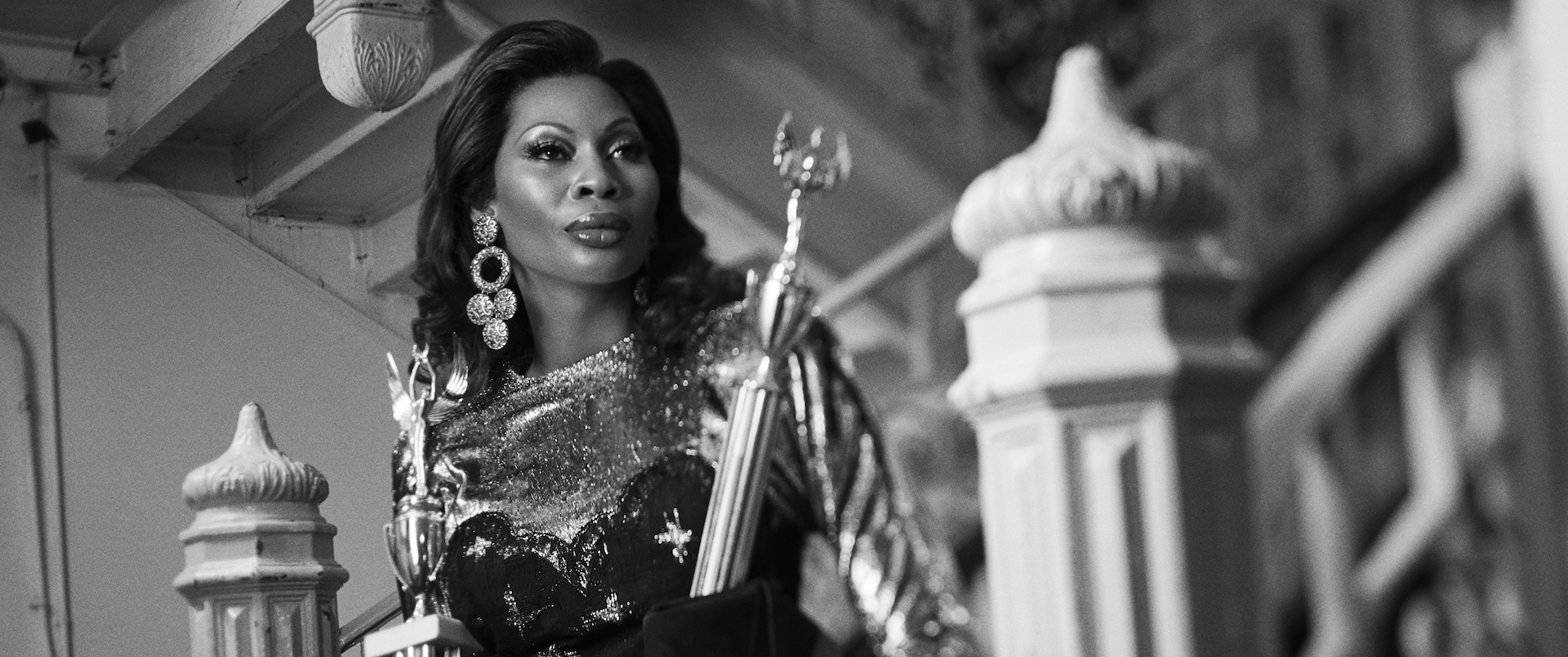
Head over to the Pride Hub under Browse, and you’ll find an official Pose playlist that updates each week with music from the most recent episode. In addition, Pose stars Dominque Jackson, Indya Moore, Billy Porter, and Mj Rodriguez curated their own respective “The Category Is” playlists. Each one revolves around a specific theme relevant to the cast member who curated it.

We also had an opportunity to ask Mj, Dominique, Indya, and Billy about their Pride Month anthems for this year—and what they think their characters’ Pride Anthem would be.

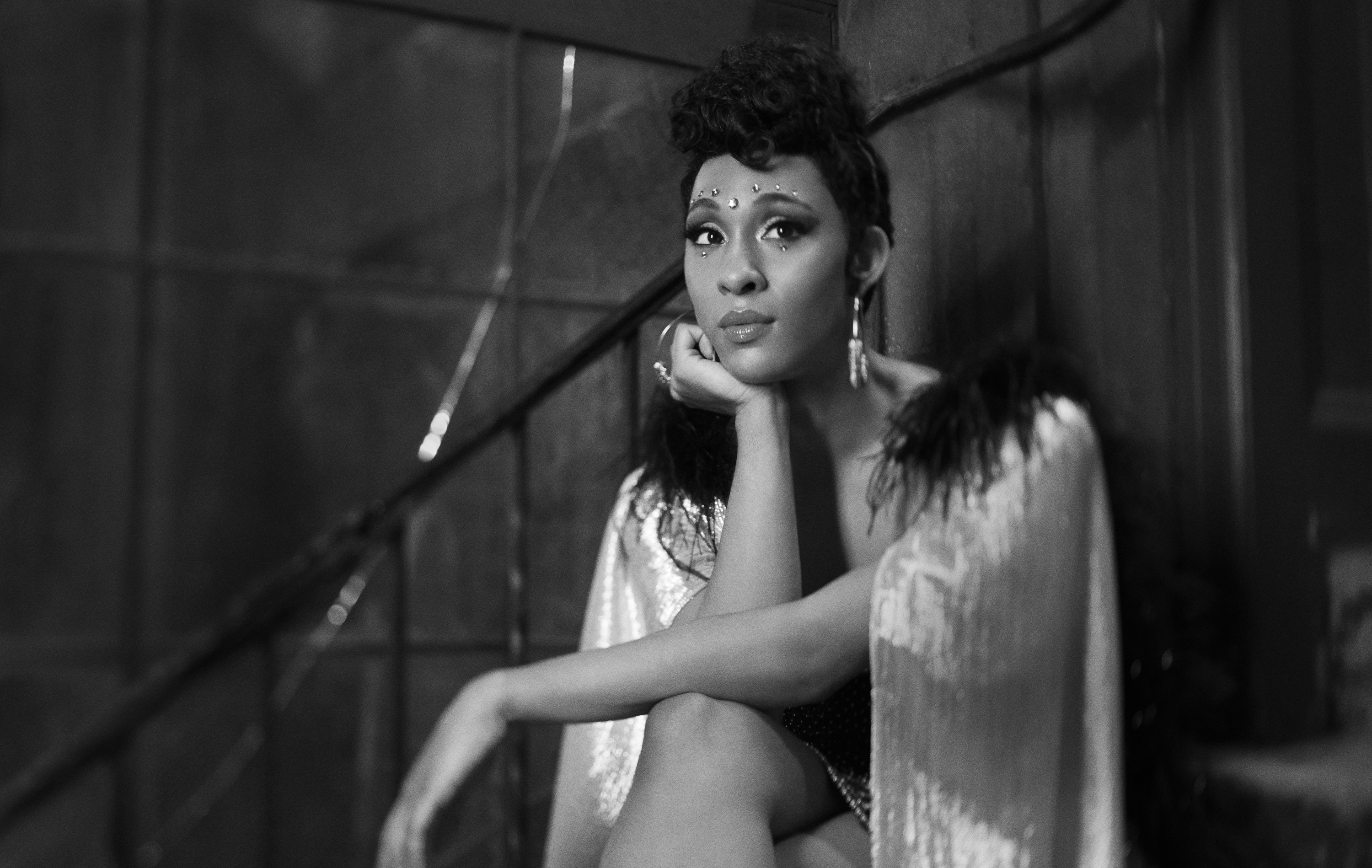
Mj Rodriguez AKA “Blanca Evangelista” – The Category Is: Power

POSE — Pictured: Mj Rodriguez as Blanca. CR: Pari Dukovic/FX

I think it’s been my anthem every single Pride—‘I’m Coming Out’—by the one and only Diana Ross, because it speaks for so many individuals. It’s not just speaking to the LGBT community. Yes, it was geared towards us and we made it our own (and she also kinda wrote it for us), but now it’s broadened. We’re speaking for everyone—everyone outside the LGBT community, allies, and people inside of it as well.”

“I think Blanca’s Pride Month anthem would be ‘The Boss’ by Diana Ross. Not only is Blanca just pure love, but I think love shows her every single time who is the boss. And I think she takes heed to that.”

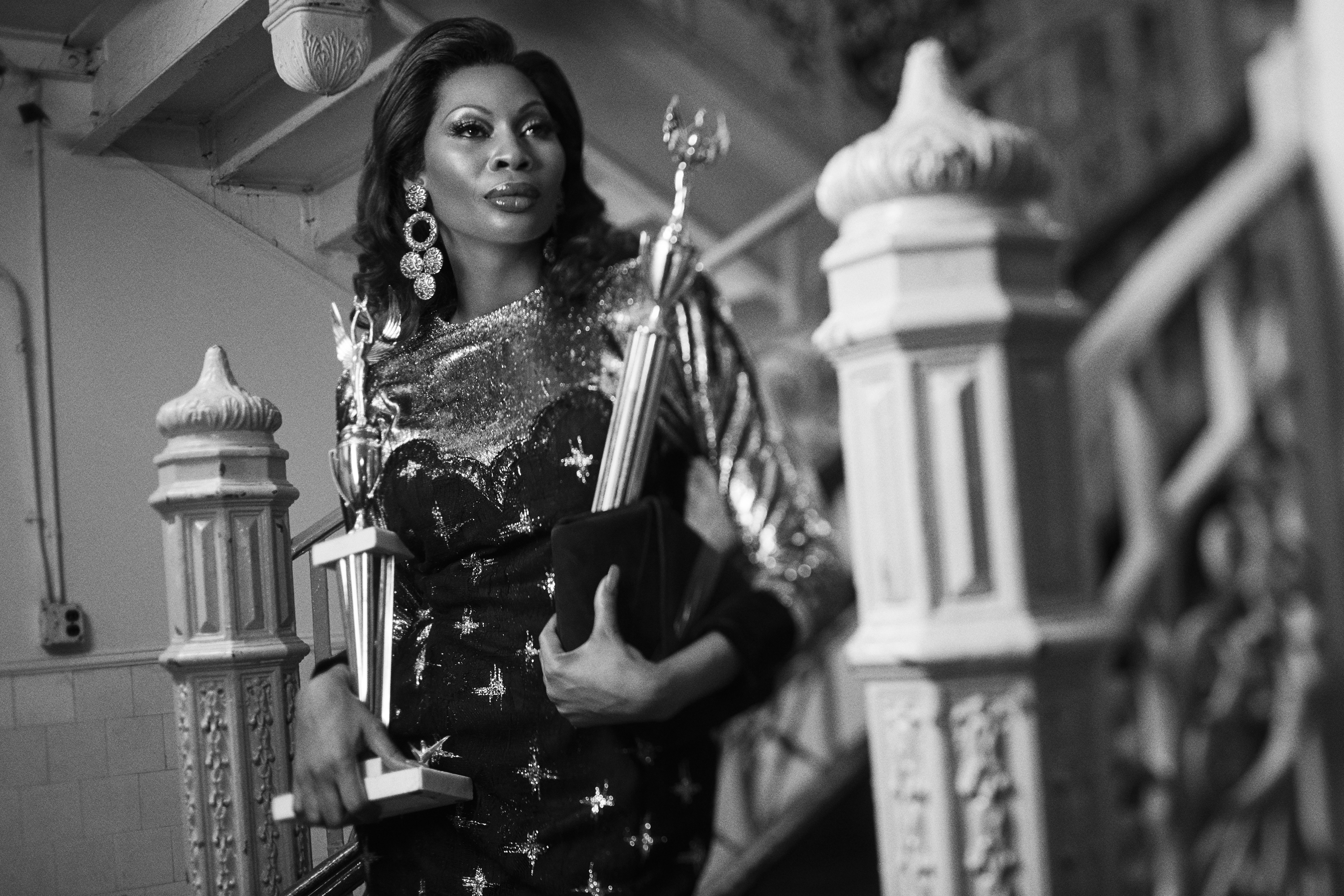
Dominique Jackson AKA “Elektra Abundance” – The Category Is: Beauty

POSE — Pictured: Dominique Jackson as Elektra. CR: Pari Dukovic/FX

“My Pride Month Anthem this year is Alicia Keys, ‘Girl on Fire.’ Truth.”

“My character Elektra’s Pride Month anthem would probably be ‘It’s all about me.’ Is there a song like that?”

Indya Moore AKA “Angel Evangelista” – The Category Is: New Day

POSE — Pictured: Indya Moore as Angel. CR: Pari Dukovic/FX

“My Pride Month anthem for this year is ‘Free’ by Ultra Nate. The song inspires me to own my freedom and autonomy while encouraging me to be generous and show up for other people, especially while queer and gender variant people are being systematically targeted.”

“Angel’s Pride Month anthem would be something upbeat. Angel is in pursuit of something new and she can’t wait to arrive there and find it. Whether that be a new beginning of love or the start of her career… Angel can’t wait!”

Billy Porter AKA “Pray Tell” – The Category Is: Love

POSE — Pictured: Billy Porter as Pray Tell. CR: Pari Dukovic/FX

“‘Love Yourself!’ My song. I’m coming back into the music business with this one, into the R&B/Soul side of the business with this one, and I’m taking my power back. And that’s my anthem.

“If Pray Tell had a Pride Month anthem… ‘Mighty Real.’ Sylvester. He loves Sylvester.”

Turn up the volume this Pride Month with plenty more Pride Playlists, including Out Now, Pride Classics, and Latin Pride, as well as podcasts from LGBTQ comedians and storytellers, all on the Pride Hub.

5 Artists Rocked By Freddie Mercury, the Flamboyant King of Queen

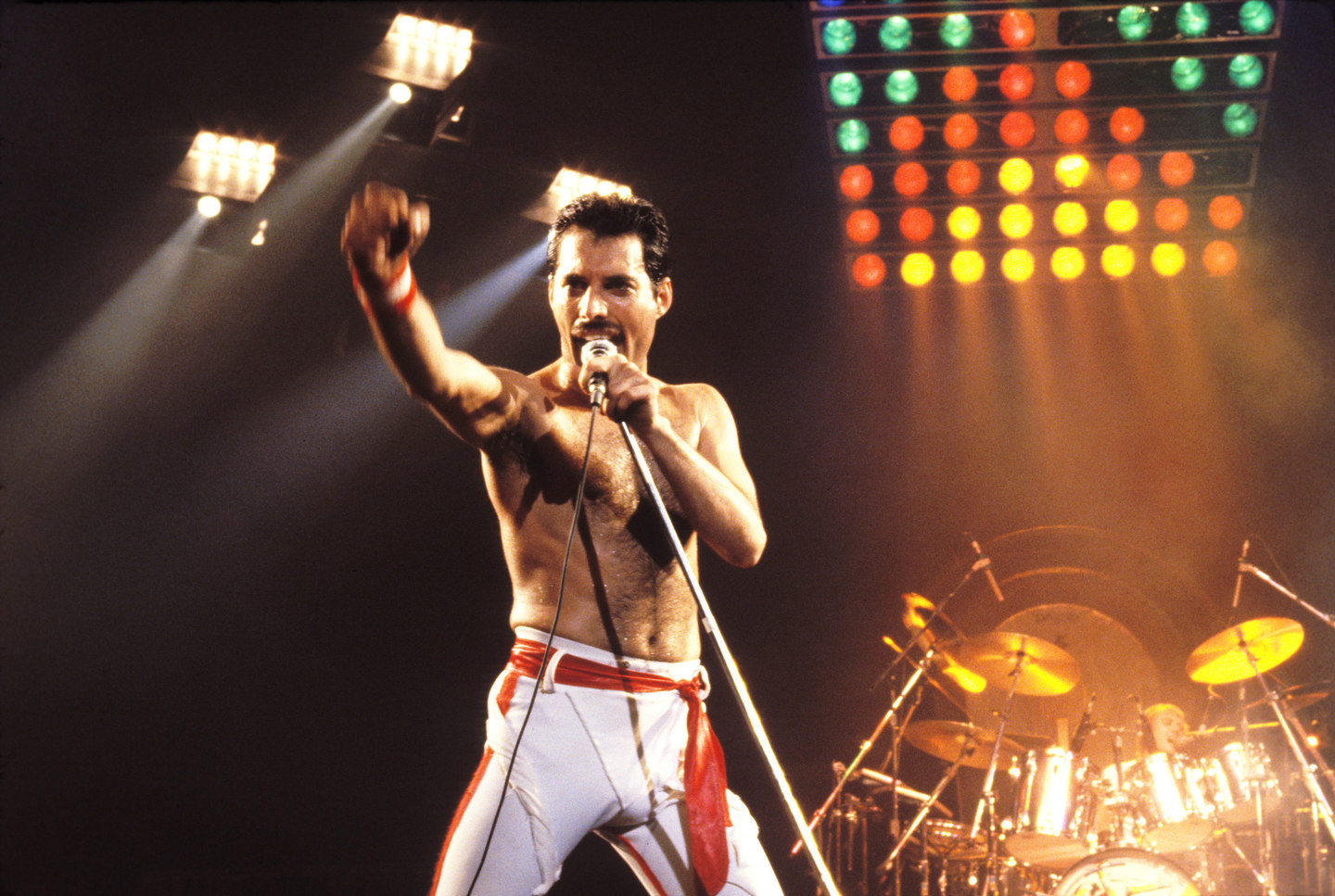
He captivated the crowd in a catsuit, hitting a free and unpredictable vibrato. A master of reinvention and a flamboyant front man, Freddie Mercury’s operatic displays were part concert, part theatre, part fashion show. Fans never tired of watching the king of Queen kick, jump, and prance across an arena, but it was his powerful yet deeply sensitive performance style—from soft piano ballads to wild, aerobic onstage antics—that touched them to their core.

Queen’s larger-than-life rock ’n’ roll has been revered and imitated for generations, and now, with the film Bohemian Rhapsody debuting October 24, we get a more intimate look at Mercury’s lasting influence as a thrilling and dynamic rock singer. The new biopic digs deep into the life of the late musician, portrayed by Rami Malek, and recreates his electric stage presence (including Queen’s iconic set at Live Aid in 1985).

Mercury’s star power was apparent from the start. Beginning with the release of its self-titled debut in 1973, Queen developed their own distinctly campy, vaguely classical style, combining elements of prog rock, glam rock, and heavy metal. No matter the genre, Mercury’s magnetic charisma and musical prowess won over fans, critics, and contemporaries. If not for his untimely death in 1991 Queen could have continued, but Mercury’s legacy lives on. See how he’s rocked us all: In honor of Bohemian Rhapsody and as a tribute to music royalty, take a look at five artists who’ve bowed down to the greatness that was—and continues to be—Freddie Mercury and Queen.

Lady Gaga

Stefanie Joanne Germanotta famously took her stage name from the song “Radio Ga Ga,” and throughout her career, she’s never forgotten her devotion to Queen; Lady Gaga has repeatedly borrowed from the Freddie Mercury playbook with elaborate outfits (meat dress, anyone?) and theatrical antics both onstage and off. In 2009, she described her favorite Freddie performance in Rolling Stone. “Freddie created this image of himself as rock royalty,” she explained. “That performance screams, ‘Watch me! I’m a legend!’”

Katy Perry

Like Lady Gaga, Katy Perry is a pop star who loves drama—from colorful costumes to bold, unafraid lyrics, she’s a singer who loves to make a splash. “Queen’s track ‘Killer Queen’ made me discover music and helped me come into my own at the age of 15,” she once told Cosmopolitan. “The way Freddie Mercury delivered his lyrics just made me feel like a confident woman; I’d say his fingerprint is all over me in general.”

Yeah Yeah Yeahs

Early 2000s indie rock goddess Karen O and Yeah Yeah Yeahs weren’t exactly subtle. The band has been on hiatus since 2013, but few can forget Karen’s onstage attire, which was often daring, dramatic, and androgynous in style. Similarly, her vocals could be big and bold one moment, quiet and delicate the next. Listen to a song like “Maps,” with its hard-rocking, sentimental theatrics, for proof of Freddie Mercury’s influence.

Metallica

While Queen combined various genres of music, hard rock—with its over-the-top instrumentation and high drama—was always at the heart of their style. Metallica, one of the biggest metal bands in the world, owes a lot to the mainstream path paved by Queen in the ’70s and ’80s. In addition to their many operatic stage shows (featuring lasers and multi-day setups), Metallica is known for their wild cover of Queen’s 1974 metal-esque song “Stone Cold Crazy.”

Dave Grohl

As drummer of Nirvana and guitarist of Foo Fighters, two of the biggest rock bands ever, Dave Grohl knows what it’s like to perform for giant crowds. In his expert opinion, though, Freddie Mercury did it better than anyone else. “Every band should study Queen at Live Aid,” he told NPR. “I consider [Mercury] the greatest front man of all time.”

While you wait for Bohemian Rhapsody to hit theaters, stream the film’s thrilling, just-released soundtrack below.

EuroPride 2018: Identify-ing the Music of Diversity

Thomas Sekelius’s favorite EuroPride memory is deeply personal—and musical. “Singing my song ‘One More in the Crowd,’ the official Pride song, last year at Stockholm Pride was quite an indescribable feeling,” he recalls. “Not only did I sing a song of my own in front of hundreds of people dancing and cheering, but I got to stand for a cause that I have preached since day one. That was so genuine.”

While U.S. Pride wrapped up at the end of June, the party is just getting started in many parts of the world, including our home country of Sweden. Right now, the continent’s annual EuroPride celebration has just kicked off in Stockholm, where we are currently launching its new original podcast series, Identify, hosted by Thomas.

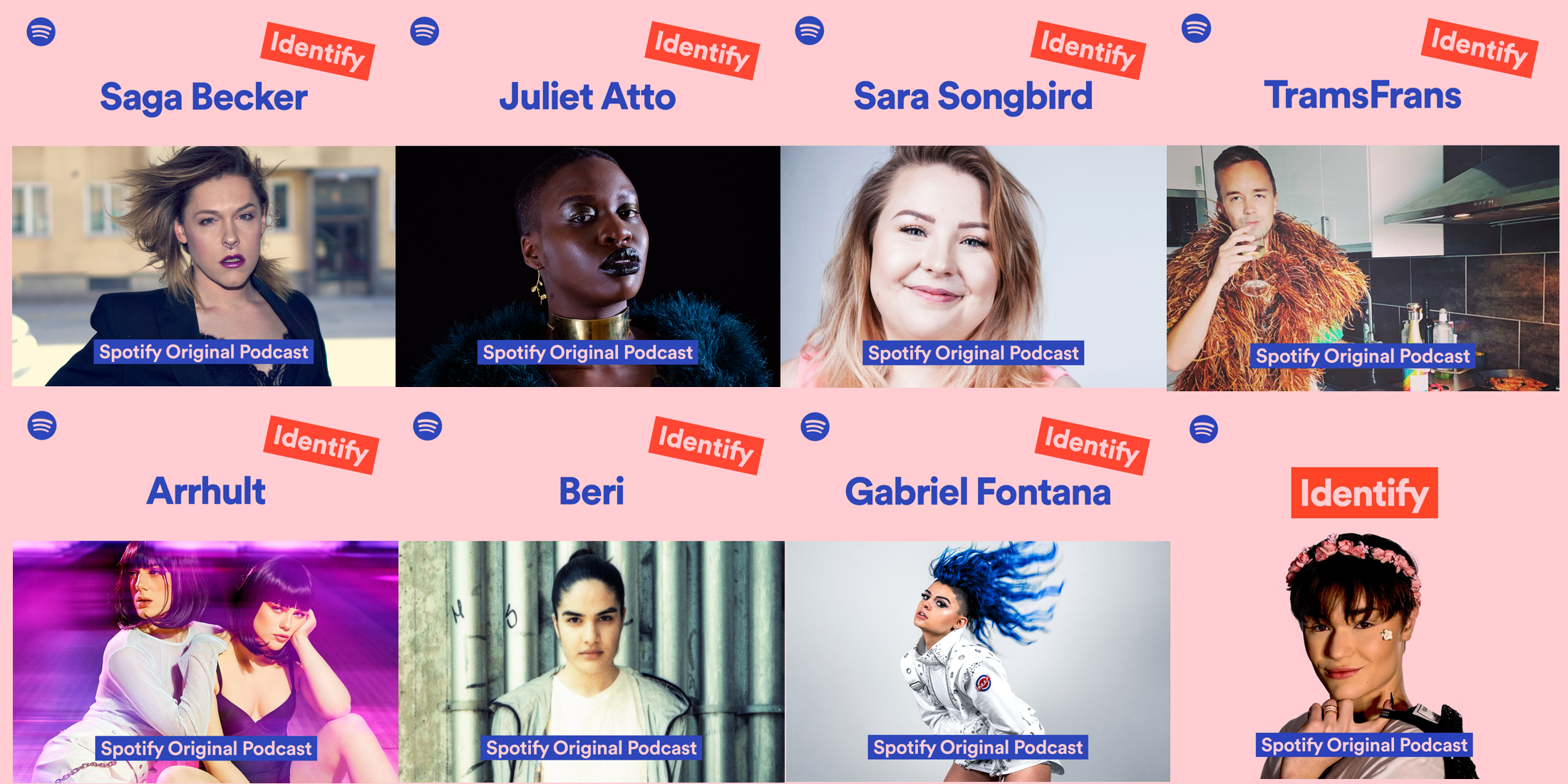
Identify investigates how music helps construct a person’s sense of self. The podcast features celebrity guests—including sibling duo Arrhult, writer TramsFrans, actress Saga Becker, artist Gabriel Fontana, activist Juliet Atto, YouTuber Sara Songbird and rapper Beri—sharing intimate stories about how music has shaped and influenced them. Each celeb has also created a playlist of inspiring songs, available until the end of August on our Pride Hub in Sweden.

To learn more about Identify, we spoke with Thomas Sekelius about the message behind the series, what it’s like to be LGBTQ in Sweden, and the music that’s helped shaped who he is today.

Thomas Sekelius, host of Spotify’s Identify podcast

Q: EuroPride is underway in Stockholm – what are you excited for?

A: I’m looking forward to seeing the community come together to paint the city in the colors of the rainbow while being the absolute proudest they can be. Pride Week is full of events that in one way or another fit everyone and will guarantee an amazing few days. But let’s not forget that not only this week, but the entire year is equally ours as anyone else’s. Diversity, diversity, diversity. Embrace it!

Q: What is unique about being LGBTQ/coming out in Sweden?

A: The overall acceptance of LGBTQ people in Sweden is pretty far along compared to other countries. This doesn’t mean that we should relax and be satisfied. We have a long way to go, in Sweden as well as other parts of Europe and the world. Even though acceptance has been better by the people there is still a lot of discrimination against more marginalized groups. So more safe spaces are needed for sure until we are all treated the same.

Q: You are open about your sexuality in your song “Awakening.” Why is music a good outlet for coming out?

A: Music plants a feeling in the people listening. Instead of only writing them down, you can combine those words with a melody and a massive production and give everyone a chance to almost actually taste the rainbow. You can really capture a feeling.

Q: As the host of Identify, you ask your guests questions about how music has shaped their identity. What are three times when music shaped yours?

A: When I was little, in my preteen years, and within the last two years. When I was little, I used to love listening to music in Swedish, English, and Hungarian, which is my mother tongue. I could float away to the land of music. I found so much happiness in music. When I was in the seventh and eighth grades, I had a hard time in school and could find both strength, peace and a trigger to my tears in music. I was also in musicals, training with a vocal coach, singing in a choir, and so on. Music was a big part of my life. The last few years, I went deeper. I began finding an interest in writing music and paid more attention to the production of songs, whereas before I mostly just listened to melodies, voices and lyrics for the overall feeling. Today, I aim to write my own songs, and am learning step by step how to produce my own product.

Q: Why is it important to feature diverse members of the LGBTQ community in your podcast?

A: People all over the world might be in a minority such as LGBTQ, but they’re still different in sexuality, ethnicity, opinion, and perspective. I wanted to make sure I didn’t just interview people with similar backgrounds. I wanted to showcase diversity to raise the bar for learning while listening.

Check out the Identify podcast and the EuroPride Hub, now available through the end of August.

Watch Hayley Kiyoko and Troye Sivan Light Up The World With Pride

During summer’s celebration of LGBTQ Pride, music plays a big role. After all, it’s one of the most powerful mediums for personal expression, and songwriting in particular can take a rallying cry and turn it into art.

Here at Spotify, with over 170 million listeners globally, we have the unique ability to literally take the musical pulse of multiple continents at any given moment. We can tap into that rallying cry, expressed through music, and watch it undulate across the globe.

So what have we discovered, from a musical perspective, during Pride season? Simply stated, when there is a Pride parade, there are epic bursts of music. On Spotify, fans have made over half a million Pride/LGBTQ-themed playlists, and they stream throughout the summer, as celebrations sweep from one country to the next.

Our data scientists have captured that excitement here with a visual timelapse map and two playable audiographics (just click on the map and listen to the artists!) that show how Spotifiers celebrate Pride—and the songs that bring it to life.

Here, we looked at anonymous listens to those playlists in countries with Spotify on each day during last year’s Pride season, and put them on the map below. We’re sure that 2018 should be just as loud and proud.

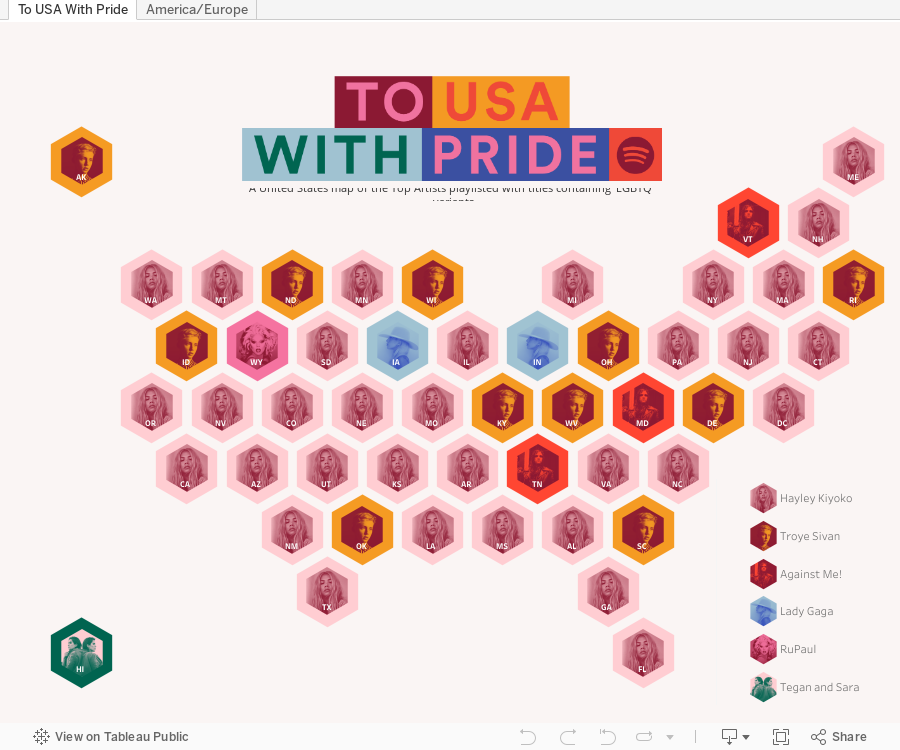
And if you’re wondering which artists appear most frequently in American playlists (those with the acronym LGBTQ are generally created in the United States), check out the interactive map below.

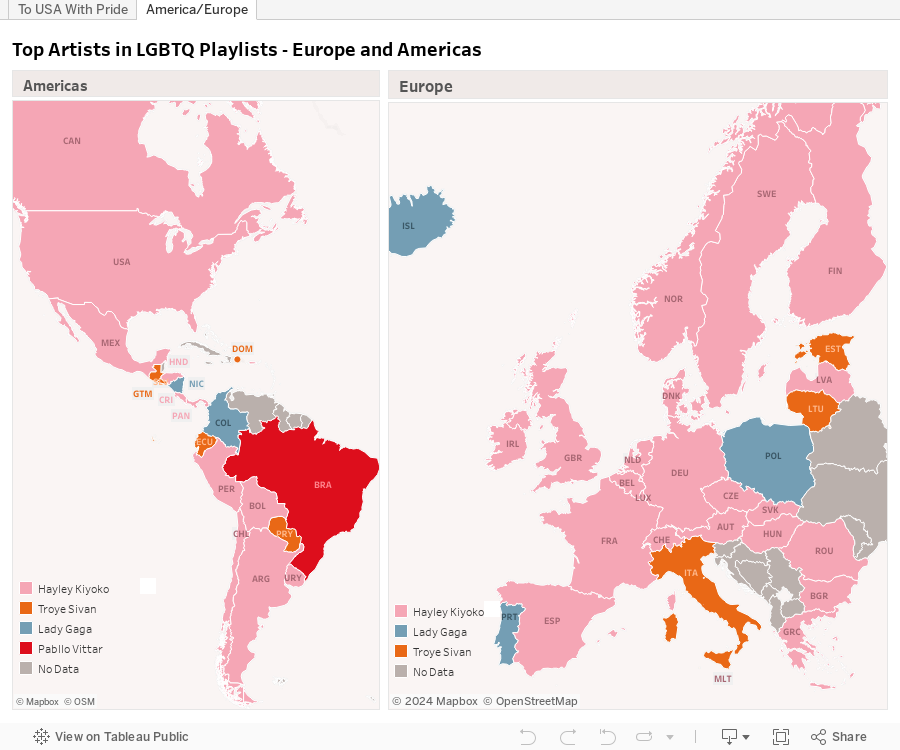
When it comes to listening, LGBTQ-themed playlists are streamed most in Europe and the Americas. Here are the top artists included on lists in those countries.

Which musicians dominate Pride globally? Well, Brazilian drag star Pabllo Vittar appears the most in LGBTQ playlists created in Brazil. And in Europe, Troye Sivan dominates in Estonia, Italy, and Lithuania; Lady Gaga rules in Iceland, Poland, and Portugal; and relative newcomer Hayley Kiyoko claims the top spot in the rest of Europe, most of the Americas, and the majority of the US, despite releasing her debut album only a few months ago (March 2018).

Check out all of these inspiring anthems and plenty more on the Spotify Pride hub.

Tableau visualizations by Spotify Data Visualization designer Skyler Johnson.