Tag: q&a

How the Story Pirates Team Uses Kids’ Imaginations to Create Audio Magic

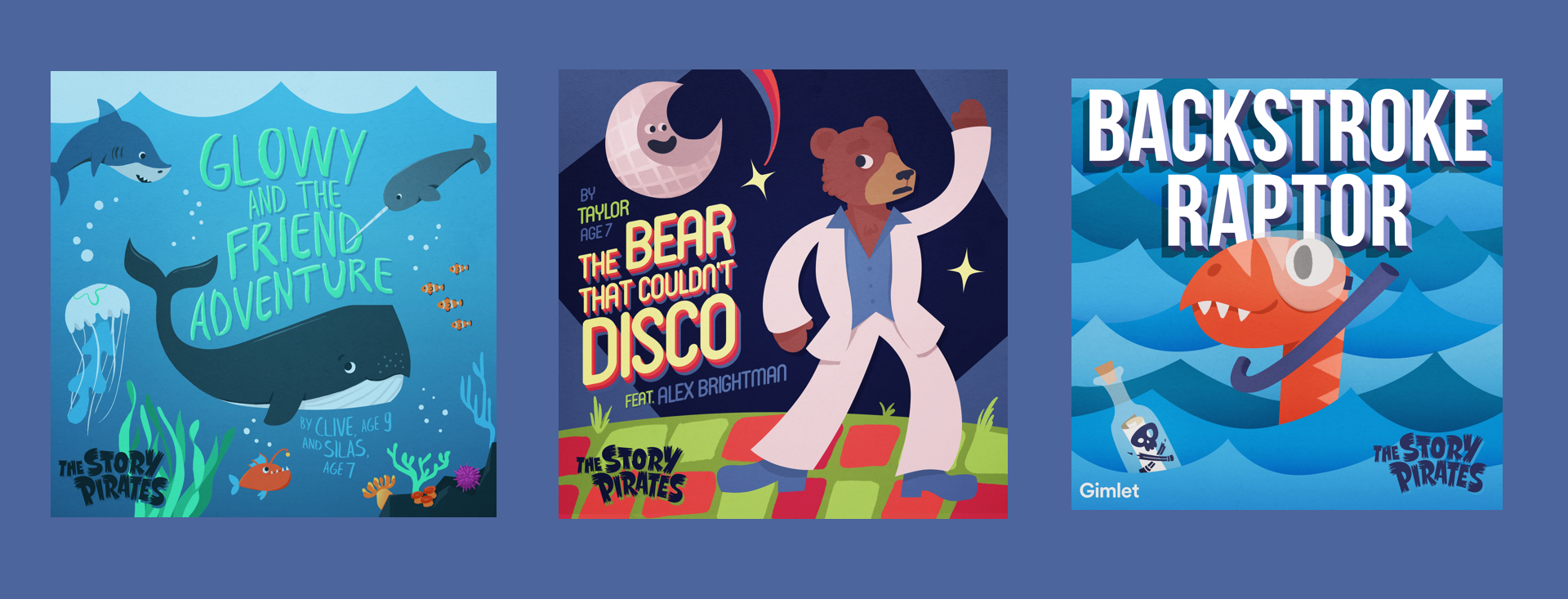
What happens when you take story ideas straight from a child’s imagination and put them in the hands of some equally creative, fun-loving, musically inclined adults? You get Story Pirates—a children’s media company turned podcast with stories by kids, for kids.

According to creative director Lee Overtree and CEO Benjamin Salka (a.k.a. Jamie), Story Pirates started off performing children-inspired musicals in schools and theaters as a live touring group in 2004 and eventually evolved into a radio show, bringing heartwarming and engaging stories to even more listeners. More recently, the company transitioned into a podcast that has spawned several music albums.

So how does it work? Youngsters from all over the world submit their ideas to the Story Pirates website, then the creative team (comprised of world-class actors, comedians, improvisors, and musicians) selects and adapts them into podcast episodes filled with sketch comedy and musical theater. Episodes even have special celebrity guests each week.

Kids (and parents!) love the original songs sprinkled throughout the show. So, to give fans more of what they love, Story Pirates released two albums—Backstroke Raptor and Nothing Is Impossible—which take the best songs and remix them into standalone versions that are easy to find and play in album format on Spotify.

We sat down with Lee and Jamie to talk about what makes the Story Pirates podcast and albums such a beloved phenomenon.

What do you think it is about podcasts that makes them a great storytelling medium for kids?

Lee: Well, audio amplifies imagination, right? It allows the listener to engage in a way that a visual medium doesn’t. You have to be involved, and for kids who are eager to live in a participatory world, a medium like podcasting is very natural for them.

What’s the most surprising thing you’ve learned since embarking on this podcast and album journey?

Jamie: The thing that surprised me most is just how authentically people are responding to what we’re putting out there. Story Pirates has been a slow, steady build—the live show started in 2004. But the last couple of years have been astronomical in terms of the growth. We hear from people who drove eight hours to see us in person or even flew in from Australia. I think it’s because families are responding to what’s different about what we’re doing. I think it feels more playful, more connected, and more joyful than what they expected.

How do you differentiate between the albums and podcast?

Jamie: One of the things people love so much about our podcast is the music. But the podcast runs anywhere between 22 minutes and a half hour, and the songs are wrapped up in the whole show. So if you get obsessed [with a song], you have to rewind and fast-forward to find your favorite part, whereas with the album, you just get right to it.

Lee: The albums that we put out through Gimlet are the best songs from the podcast remixed and remastered. So most of the songs on the album are ones you’ve heard in a different form on the podcast. For example, Lin-Manuel Miranda wasn’t on the podcast version of “The Wizard Who Could Just Go Poof,” but he was on the album version.

Speaking of Lin-Manuel, who are some of the other guests that you’ve had on the show, and who are your favorites that you’ve worked with so far?

Lee: We’ve been really lucky, and it’s sort of gone from us reaching out to our contacts in the comedy community to people reaching out to ask to be on the show because their kids listen. We’ve had lots of great people, like John Oliver, Claire Danes, Dax Shephard, and David Schwimmer. And we have some more really exciting guests coming soon.

Introducing Spotify Kids, A New Standalone App for the Next Generation of Listeners

Spotify is committed to bringing audio content such as music and stories to more people in more ways–including the next generation of listeners. That’s why we decided to launch a fun standalone app designed with safety in mind specifically for kids and families.*


We sat down with Alex Norström, Spotify’s Chief Premium Business Officer, to learn a little more about the app. 

1. Why create a Spotify Kids app now? What can users look forward to?

We know that families love listening together—whether it’s while driving in the car or cooking dinner together in the kitchen. But we also know that family members love to listen on their own too. That’s why we’re so excited to welcome the next generation of listeners—kids—into the Family Plan experience. 

Kids consuming audio content, such as music and stories, isn’t a new phenomenon—in fact, they love it. But most audio experiences were built with adults in mind—meaning they’re not simple, easy, or fun for young kids to use. 

Spotify Kids was born out of the desire to create a playground of sound just for kids—to build a place where younger kids can explore their favorite music and stories in a fun environment. The content is ad-free and hand-picked by a team of editors, and the experience is bursting with color. Our visuals help guide young minds through the app with simple navigation and scaled-back text. Before setting out to explore, each kid can also select a custom avatar and color theme to personalize their experience. 

Spotify Kids is a composite of playlists, which makes it easy for kids to find music and stories from their favorite movies and TV shows or hit plays on a playlist to sing along to during their favorite activity—or their least favorite chore.  

We’re thrilled to beta launch in Ireland and look forward to introducing Spotify Kids in all markets that have Premium Family in the coming months. As we evolve the app experience, we’ll roll out enhanced parental settings and controls for even more customization in an effort to give parents peace of mind. 

2. How is the Spotify Kids app different from the original app? Any unique content?

Spotify Kids is a standalone app available exclusively for Premium Family subscribers and intended for kids ages 3+. The content within Kids is hand-picked by a team of editors, who have nearly 100 years of combined experience curating content for kids. They come from some of the most well-respected brands in this space, including Nickelodeon, Disney, Discovery Kids, and Universal Pictures, as well as Public Service in Sweden and BookBeat, which is a family- and kids-oriented audio streaming service.  

Beyond the content, the entire Spotify Kids user experience looks and feels different from the Spotify app. And that’s intentional. It’s built for kids, with their specific cognitive skills in mind, and exudes a fun, familiar, playful, and bright atmosphere. This look and feel also varies by age group—for example, the artwork for younger kids is softer and character-based, while content for older kids is more realistic and detailed. 

3. Why launch in beta? What are you hoping to learn? 

Having a standalone app specifically for younger kids is a new space for Spotify, and we understand the sensitivities around content for children. We are being very deliberate in our launch approach. We’ve started with a beta launch in Ireland, knowing that this initial roll-out phase will yield many learnings from parents, caregivers and other experts as they begin to interact with the app.

As we evolve the Spotify Kids experience over time, we plan to enhance parental control features to allow for even more customization. We’ll also bring our audio expertise to the table with listening experiences that go beyond music—like more stories and audiobooks and eventually podcasts.

4. As you were building the app, did you tap any external resources? Say, consult with any parent organizations or conduct focus groups?

While launching this kids app is an exciting moment for Spotify, creating it was not a task we took lightly. We knew the importance of understanding parents’ needs and making sure they would have peace of mind about the content their kids are consuming. 

Spotify has spent more than two years learning about this space, and we’ll continue to learn as people begin to interact with the app. We have gathered expert insight from a number of organizations, including the National Children’s Museum in Washington, D.C.,  and conducted our own studies with parents around the world and tapped into our Employee Resource Groups here at Spotify.

Spotify Kids is available starting today in Ireland. Ready to get started? Spotify Premium Family master account holders can simply download Kids from the App Store or Google Play, then sign in to their regular Spotify account. (If you’re new to Spotify, you’ll need to sign up for Premium Family before signing in to Spotify Kids.)

For those outside of Ireland, Kids will be rolling out to all markets that currently have Premium Family. Be sure to check back here for more or check out spotify.com/ie/kids.

*Update March 17, 2020: Spotify Kids has also rolled out in Argentina, Brazil, and Mexico.

Update February 11, 2020: Spotify Kids has also rolled out in the UK and Australia

Update November 27, 2019: Spotify Kids has also rolled out in Denmark, Sweden, and New Zealand.

Update May 12, 2020: Spotify Kids has also rolled out in Germany and Japan.

Sten Garmark, Spotify’s VP of Product, Unpacks Our Ubiquity Strategy

Perhaps you start your morning by streaming a pick-me-up playlist on your phone. Then, as you settle in at work you queue up some motivational songs on your laptop. After you get home, you play a podcast on your voice-activated speaker as you prep dinner. Because Spotify can be with you wherever you are, in any environment, audio opportunity abounds.

We sat down with Sten Garmark, our VP of Product, to learn more about the times, places, and situations in which audio can play a role—but with less work needed to access and play the content you want.

Tell us about your mission at Spotify and, specifically, your focus on ubiquity. How will listeners benefit?

As the delivery of audio content becomes all the more intuitive and seamless, our ubiquity strategy involves creating a truly frictionless experience for consumers. In other words, it’s to take whatever moment you’re in—if you’re driving, in your home, if you’re on your headphones, if you’re exercising—and make sure that you can get to your Spotify experience as easily and as quickly as possible.

The end state here is to ensure that Spotify aligns more deeply with the multiple devices in your life so that you won’t need to find the songs or podcasts to suit the moment—they will find you.

How do we deliver on the promise of ubiquity at Spotify? And what’s the entry point?

Our ubiquity strategy is very much mobile first, since most of our users today are coming in on their phones. If that’s their first touchpoint, then it’s about expanding that to more situations. We think that’s going to continue for quite some time.

From there, we need to be technically integrated with all the devices around you to enable a great Spotify experience that, to you as a consumer, intuitively works. That requires making sure that the integration for our partners is simple, such as with a voice-activated speaker.

At the end of the day, we need to deliver a simple solution for all: our users, partners, and creators.

Describe the opportunity for audio ahead. How do you ensure that listeners are aligned with that vision? 

As mentioned, the strategy is to make everything less complicated. It’s reducing work that you have to do—making sure that you don’t have to be that technically advanced to be able to get to Spotify wherever you are. If there are, say, currently five steps to navigate something, we at Spotify ask, why should our users have to navigate at all? Can we remove steps? 

We believe that we can take users on a journey to reevaluate audio and get more out of their lives with content from creators—in the right place at the right time. We think it’s less about listeners aligning with our vision than it is about us aligning with their behavior.

Some say that there can be too much screen time. Is there such a thing as too much audio as well?

It isn’t really a comparable analogy. For example, music speaks more to moods. It’s complementary: it’s not taking you away from your family, it’s not taking you away from your social interactions. It enhances those moments of your life. And with podcasts, we see that many people want to engage with longer-form content that goes deeper into a variety of topics, giving them a richer understanding of the world around them. We hope that that can be a really powerful force in society. 

Visit Explore Spotify to find playlists that suit a variety of moods and situations.

6 Questions (and Answers) with CEO Daniel Ek about Spotify and Samsung’s New Partnership

It’s never been easier to play music on-demand. With your trusty smartphone and handy Spotify app, the music you love is no more than a few taps away. But when it comes to playing across your many devices, things aren’t as simple.

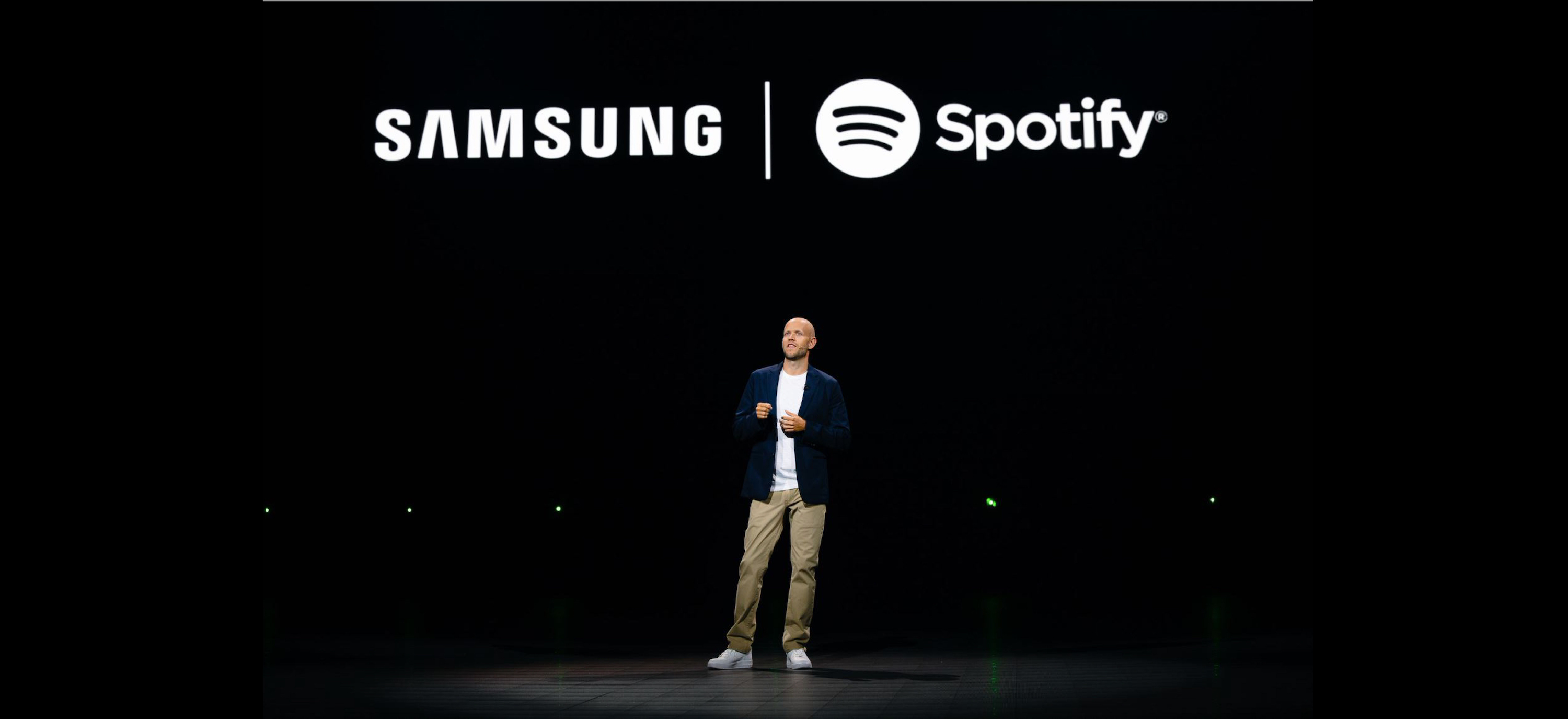
That’s why we’re excited to share that Spotify has been named Samsung’s new go-to music service provider, which gives Samsung users a seamless listening experience between devices. You can look forward to a more meaningful music experience, thanks to integrations across a variety of Samsung products.

We sat down with Spotify CEO Daniel Ek to ask a few questions about Spotify and Samsung’s partnership:

What inspired this integration?

Since Spotify’s inception, we’ve studied how people use Spotify. We know that listeners stream different kinds of music at different times, in different places, and most importantly, on different devices. We think music should be easy to access on ALL of your devices—and we want it to be seamless to switch from one device to another.

Why did you choose to partner with Samsung?

Samsung makes devices for every aspect of our lives – everything from smartphones and TVs, to tablets, speakers, and watches. And we have designed Spotify to deliver personalized music to consumers around the world – wherever they are, across millions of devices. This partnership with Samsung reduces the friction for users to get Spotify up and running on multiple Samsung devices once the accounts have been linked. It allows us to create a seamless music listening experience together for the user that would be hard for either of us to build alone. It’s a great fit.

What can users look forward to right away?

First off, users can get excited about Spotify becoming part of the set-up experience on a Samsung device from the very beginning. For example, when someone buys a phone, the user can easily discover the Spotify app on Samsung Smart Switch. And soon, Samsung Smart TV users will be able to play Spotify through the SmartThings app. It’s a new level of integration that will allow Spotify to be easily accessible and discoverable on Samsung Devices. As you move from room to room, your devices will be aware of your location and prompt you to effortlessly transition your listening between them.

Next, Spotify is excited to be even more deeply integrated with Bixby, Samsung’s premier voice solution, and serve as the only music service to be fully integrated with Samsung Music. When a user asks Bixby for music, Bixby will look to Spotify—even if that user has never used Spotify before—allowing listeners to receive recommendations from Spotify, discover new playlists, and create new musical experiences.

How does this “seamless control” make switching between devices easier?

The short answer is that on several key Samsung surfaces, you’ll be able to link your Samsung and Spotify accounts to play music across all Samsung devices.

The [slightly] longer answer is that – for example – when you buy a new Samsung phone and use the SmartThings app to set up your Samsung Smart TV or Galaxy Home, you will be prompted to link your Spotify account. So right from the beginning, you’ll have that collaboration. It only takes a few simple steps.

Additionally, we’re also making it easier to move playback to various hardware devices with Spotify Connect. When a user enters WiFi while listening to music on mobile with the Spotify app, they’ll be able to move playback from the mobile lock screen, instead of having to go back in the Spotify app.

How will this integration benefit existing Samsung users?

As Samsung’s new go-to music provider, Spotify is giving hundreds of millions of Samsung listeners better access to our 35 million songs, as well as our innovative Discovery and Personalization features, connecting more artists with more fans.

We believe that this significant long-term partnership will provide Samsung users across millions of devices with the best possible music streaming experience, and make discovering new music easier than ever – with even more opportunities to come.

Of course, it will also help artists reach new fans. Our goal has always been to make music accessible to everyone by giving a million creative artists the opportunity to live off their art and billions of fans the opportunity to enjoy and be inspired by it.

Do Samsung and Spotify users have any other features to look forward to going forward?

We’re excited for the future of this incredible partnership. Users will be able to discover and enjoy new music in ways that have never before been possible.

As my friend DJ Koh (President & CEO, IT & Mobile Communications, Samsung Electronics) said today, “With Spotify, Samsung Galaxy users will be able to enjoy seamless music experiences across all our devices. We’re excited about today’s announcement, and it’s just the start of things to come!”