



Tag: latam

Spotify’s ‘Morning Coffee’ Franchise: A Daily Original News Podcast Brewed Especially for Latin America

Those who like to start their day with news podcasts look for intriguing and accurate stories served up by established journalists. So two years ago, Spotify started partnering with some of the most respected news outlets in Latin America to create country-specific news podcasts. Since then, our Morning Coffee podcasts have grown into a franchise that serves four different podcasts in four different countries—with listeners throughout the region streaming daily, perhaps with a hot cup of coffee in hand. 

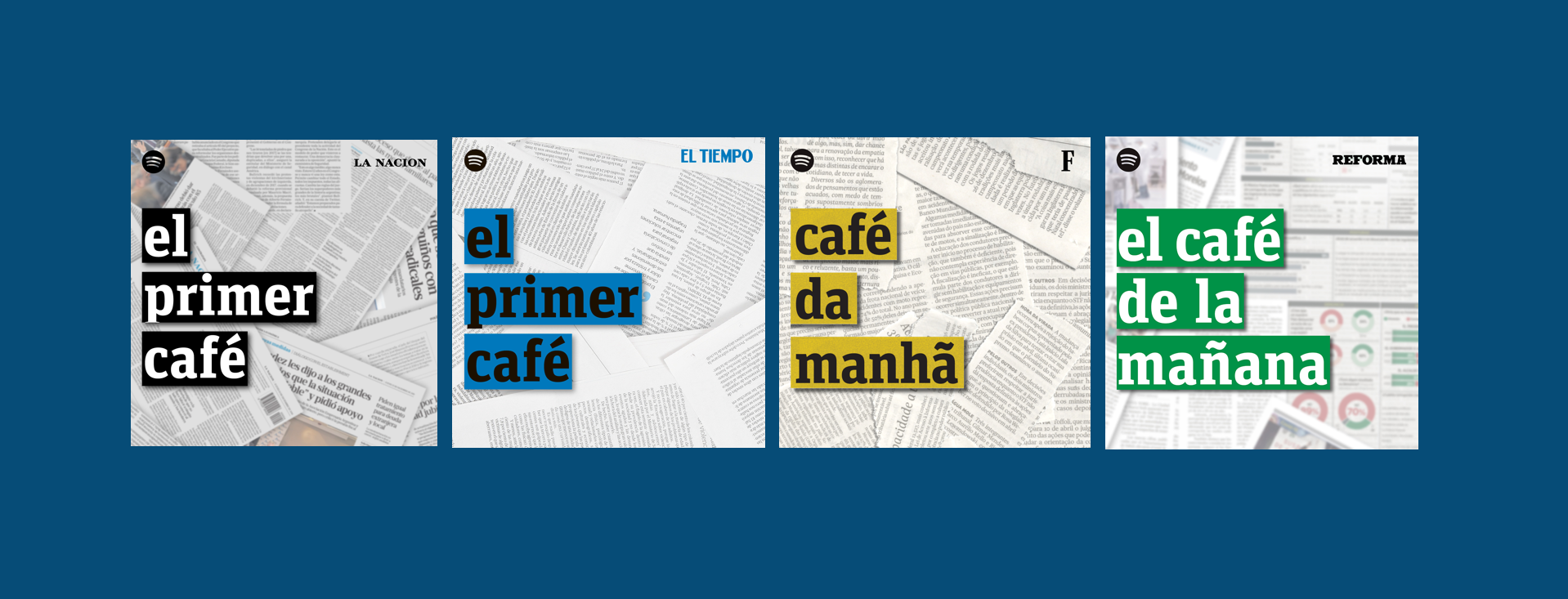
We started Café da Manhã in conjunction with Folha de S.Paulo in Brazil in January 2019. We followed with El Primer Café, first with La Nacion in Argentina (March 2019) and then with El Tiempo in Colombia (July 2019). In October 2020, we added El Café de la Mañana with REFORMA in Mexico to the franchise. As of January 11, these Spotify Original daily news podcasts combined have racked up millions of listeners and 32 million streams across Latin America. They’re streamed in over 20 countries globally—not only the four where they originated. 

In celebration of our recent launch of El Café de la Mañana in Mexico and the two-year anniversary of the first Café, we sat down with Spotify’s Head of Studios, Latam & US LatinX Javier Piñol to hear how the idea for the franchise came to be and what it has become. 

What’s the main idea behind the Café franchise?

We noticed a blank space in the Latin American market when it came to daily (Monday through Friday) news shows. So we seized on the opportunity of creating a daily news podcast hosted by the most respected voices. We believed we could do this in a unique way by partnering with the most respected news outlets in Brazil, Mexico, Argentina, and Colombia and by showcasing the voices of young journalists who could help us connect with younger audiences. 

What is consistent among each of the four shows? What’s unique?

For starters, each of the shows has been among the top ten most-streamed podcasts in each of their respective markets at some point. There are two hosts, a young man and woman, at the same level, from the news outlet with enjoyable banter and an eye—and ear—for interviewing and telling stories. They each showcase the news you need to know to start your day. Individually, each show caters to its listeners. For example, El Primer Café in Colombia skews longer, with episodes lasting 40 to 60 minutes, while El Café de la Mañana episodes are often less than 20 minutes long. Some focus on one theme or topic, while others are more of a news roundup. Each podcast is recorded at the media outlet’s newsroom, which allows for unparalleled access to expert voices on each news subject.

How has the franchise made its mark in Latin America?

These shows—and therefore Spotify—have become a reference in the podcast sphere when it comes to news and ways of talking about the most important stories of the day. In creating these successful shows, we’ve also brought huge developments to the podcast industry in the region and incentivized podcast production from large media companies in a formerly nascent industry. Ultimately, the series has introduced new, young listeners to podcasting and invited them to create a podcast listening habit.

What are the benefits of having a news podcast franchise?

Thanks to feedback from the news outlets we’re partnering with, we’ve gotten great feedback regarding the show and have been able to build up a network of correspondents who can be tapped for further podcast ideas. With these individual market podcasts off the ground, we also now have the possibility of exploring investigative reporting stories that span the region, not only one country.

Why is it important to have news shows like these? Why do you think the franchise has become so popular?

The Café series became popular because there weren’t similar news shows with the credibility and rigor that the news outlets bring. But the format is what kept people coming back day after day. The format is designed for people’s current lifestyles. Users can listen as they start their day and know they’ll be prepared to really talk about what’s going on in the world that day. They want rigour; they want to start out learning and then want to continue to have access to news wherever, whenever, on demand. 

What’s next for this franchise, or for podcasts in Latin America across the board?

We’ve started to share feedback and processes between the shows in order to bring our innovation between territories. For example, we are now implementing things that have worked well in the Brazilian and Mexican shows in the Colombian and Argentine ones. We also foresee that we will have more spin-off shows that could be specialized on specific themes, such as the ones we have already seen in Brazil, like Plantão Coronavirus during the pandemic and Eleição na Chapa for the last Brazilian presidential election in 2018. We’re excited to be able to bring so many new types of shows to so many listeners.  

El legendario Carlos Vives habla sobre Cumbiana y el impacto del folclor en la música latina moderna

Las gaitas y flautas de los pueblos indígenas de los Andes se unen al ritmo de los tambores de África, la armonía de los acordeones de Europa y las vibraciones de las guitarras eléctricas de Norteamérica. Es la cumbia, un género mestizo que recuerda con orgullo su herencia folclórica en el corazón de América Latina, pero que hoy en día se proyecta para el mundo con la energía transformadora de los nuevos instrumentos digitales.

“La cumbia es un espíritu que está, no solo en la música de ayer, pero que sigue presente en la música de hoy”, señala Carlos Vives, artista comprometido desde hace más de 30 años con la proyección de la cadencia de estilos como el vallenato, el porro, la cumbia y la champeta junto con otros como el pop, el rock y el reggaetón. Algunos de sus álbumes como La Tierra del Olvido y Clásicos de la Provincia han marcado hitos en la cultura al destacar autores e intérpretes caribeños de antaño junto con nuevos sonidos, para dar a conocer el folclor colombiano en el mundo.

El exitoso ejercicio se repite con Cumbiana, su más reciente  álbum que nace en las profundidades del río Magdalena, aplicando muchos de los patrones característicos del género con nuevas mezclas, sumando colaboraciones destacadas con Jessie Reyez, Alejandro Sanz y Rubén Blades. En este trabajo, el cantautor colombiano hace un esfuerzo especial por rescatar la tradición de los pueblos que habitan en la Ciénaga Grande de Santa Marta, la región donde nació. 

“La mezcla de esas culturas originales americanas con la llegada de África, se suman nuevos instrumentos y nacen nuevos ritmos de la cumbia. En el mundo real de la cumbia en la modernidad [existen] una serie de patrones que pueden ser utilizados con teclados y con los computadores de hoy”, explica. Además, para lograr la proyección de un género tan versátil, también es necesario entender sus variantes y reconocer algunos de sus hermanos cercanos como el vallenato, el chandé, la chalupas, entre otros.

Desde México y Centroamérica hasta Argentina y Chile, la cumbia fue adoptada en la segunda mitad del siglo 20 en muchos de los países de América Latina, encontrando nuevos representantes y ganando nuevos adeptos hasta convertirse en un símbolo que hace bailar a adultos y jóvenes de diversas clases sociales, reflejándose incluso en la música urbana y el reggaetón, tan populares hoy en día.

“Muchos artistas urbanos usan el patrón de la cumbia. Nadie dice ‘Hola, estoy haciendo una cumbia’, pero todos usan el patrón de la cumbia en la música urbana, destaca, haciendo referencia a canciones como Atrévete-te-te de Calle 13 u otras de artistas como Camilo o Sebastián Yatra, demostrando el impacto que tiene el género en la música latina actual. 

“El legado que espero dejar con Cumbiana es que la gente conozca el territorio donde nace la cumbia, donde se generan esa serie de patrones que se han usado en la música colombiana y que pasaron a la modernidad. Si logramos además con la promoción de esta música lograr llamar la atención de estos problemas sociales y ecológicos que tiene la región, entonces habremos de verdad dejado un legado realmente importante, y entonces ahí sí, habrá cumbia por mucho tiempo”, concluye Carlos Vives.

Escucha aquí Cumbiana, el último álbum de Carlos Vives, y conoce más sobre este género latinoamericano en el espacio dedicado a la Cumbia en Spotify.

La Reina, la playlist con Clásicos y los Nuevos Hits del Regional Mexicano

El regional mexicano es un término que comprende una familia de géneros, ritmos y tradiciones musicales del país como la música banda, norteño, mariachi y cumbia, que en los últimos años se ha fusionado con otros como el hip hop, el rock y el pop.

Para celebrar esta explosión de éxitos, clásicos y experimentos, Spotify creó La Reina: una playlist que conjuga las raíces de la música tradicional mexicana con éxitos que exploran nuevas direcciones. Un año de creación y medio millón de seguidores después, La Reina ha sido capaz de cautivar a los nativos del género y también a quienes se acercan a él por primera vez. 

“La Reina es una playlist que tiene un poco de todo lo que nos gusta a los mexicanos en el vasto espacio del Regional Mexicano. Aquí los oyentes encuentran a los reyes y reinas del género”, dice Uriel Waizel, Editor Senior de Spotify. “En Spotify tenemos el compromiso de celebrar a la música de México y en La Reina esperamos que los fans exploren las muchas facetas del Regional Mexicano y descubran nueva música que amarán.”

El objetivo al crear La Reina fue ampliar el espectro para que en un una misma playlist los fans puedan escuchar la música de leyendas del género como Los Tigres del Norte, Banda el Recodo, o Los Ángeles Azules en la misma playlist que una nueva generación que está redefiniendo el género como Christian Nodal o Ángela Águilar.

Para los fans, La Reina es una playlist para escuchar en fiestas, para cantar a todo pulmón en modo karaoke o para escuchar en el trabajo. Además, los acerca a subgéneros emergentes los corridos tumbados con artistas como Natanael Cano y Junior H que cuentan las historias de la frontera, la calle y el barrio.

Además, la curaduría destaca colaboraciones que cruzan las barreras del género, como el mariacheño y pop de Christian Nodal con Piso 21 en Pa’ Olvidarme de EllaQué Maldición donde Banda MS mezcla su sonido con el hip hop de Snoop Dogg 

No importa qué tipo de fan del regional mexicano eres, la variedad que encontrarás en La Reina: Éxitos del Regional Mexicano la hace una playlist para ti.

Fausto, Podcast de Crímenes Reales Original de Spotify, Regresa en una Segunda Temporada con un Caso Escalofriante

En octubre del 2019, Spotify estrenó el primer podcast original de crímenes reales en Latinoamérica: Fausto, con un éxito rotundo. Ahora, con la segunda temporada, llega otro caso real para desvelar: la historia de un asesinato frío, diestro y organizado. 

En noviembre de 2004, la señora Elena desapareció de su casa en la Ciudad de México.  Solo dos personas estuvieron con ella: su hija y su primo. Y versiones contradictorias sobre la presencia de un misterioso hombre abandonando la escena son sólo el principio de una sinuosa investigación. Desde la noticia del crimen hasta la cronología de los hechos es revelada, la segunda temporada de Fausto mantendrá a los oyentes en el borde de la silla.

Tal como sucedió con la primera temporada, el equipo de Spotify Studios recreó la historia con base en una detallada investigación, el acopio de los documentos del juicio y las declaraciones de los responsables del caso: fiscales, policías, peritos y testigos del proceso penal. 

A diferencia de la primera temporada, que construyó la historia con base en expedientes judiciales, esta entrega se fortalece con el testimonio de personas muy cercanas al asesino. La inconfundible voz del actor Damián Alcázar y el estilo narrativo del guión, hacen de Fausto un podcast imprescindible. Incluso los más fanáticos del género de crímenes reales se sorprenderán con el desenlace.

“Narrar la realidad es la cosa más dura, pero Fausto nos propone una manera disfrutable de escuchar estas atrocidades, la ficción nos lo permite.”, dice Alcázar “Y es ahí donde yo me engancho con las historias que tocan la sensibilidad creativa de las personas”, comparte Damián Alcazar.

“La potencia que tiene la narrativa de hechos reales captura la imaginación, poniendo al oyente en esas circunstancias y adentrándose en la complicación de los seres humanos siempre es atractivo”, añade. “Y el audio es un medio muy poderoso para contar esas historias”.   

“Estamos orgullosos de presentar una nueva temporada de Fausto, la serie de crímenes reales más escuchada de Latinoamérica y que el pasado año se convirtió en un referente del género y del formato podcast, gracias al trabajo de Damián Alcázar como narrador”, dice Javier Piñol, Head de Spotify Studios para Latinoamérica. 

¿Estás listo para una aventura? Escucha la nueva temporada de Fausto aquí.

Más allá del campo de juego: el fútbol, una pasión como estilo de vida

Es muy común que algunos momentos de felicidad nos pasen desapercibidos y en realidad, somos más felices de lo que creemos. Hay pasiones que aunque no vemos ni tocamos despiertan sentimientos de felicidad y satisfacción indescriptibles. Seguramente se escape una sonrisa en los labios de muchos al pensar en el amor, la familia, la música ¡y el fútbol!

El fútbol tiene la capacidad de conectar a las personas, especialmente en Latinoamérica donde ha llegado a convertirse en un evento cultural: al poner un pie en el estadio, el alma de los fanáticos se desborda, el fervor de los hinchas se contagia en el aire, las banderas se agitan y las gargantas vibran con cánticos a todo pulmón.

No todo dentro del mundo del fútbol sucede en el campo de juego

Este deporte tiene ese “no sé qué” que provoca un sentimiento de representación único, que trasciende a los seguidores habituales y logra que gran parte de la sociedad lo perciba como un patrimonio. De hecho, el fútbol ha llegado a ocupar buena parte del tiempo de muchas personas, tanto si se practica como si se es aficionado; aprovechar un rato para jugar con amigos los fines de semana, o comentar la actualidad de tu equipo es lo más normal del mundo.

Con el correr del tiempo y la llegada de nuevos medios de consumo y expresión, se ha despertado un creciente interés por hacer del fútbol parte de la rutina. Ya sea camino al trabajo escuchando entrevistas con los referentes del club Boca Juniors (Argentina) en Perfiles Xeneizes; sumergiéndote en un debate sobre los temas más candentes del fútbol brasilero y mundial en Posse de Bola (Brasil), o para relajarte luego de una jornada laboral informándote con Raza Deportiva (de ESPN México). Otros descubrieron un nuevo pasatiempo en las entrevistas a los jugadores más importantes con Bolívia Talk Show. También, hay quienes optan por escuchar Expediente Bianchi (Chile) para revivir esos goles que marcaron historia como método para combatir el insomnio.

Este amor tan genuino y verdadero que nos ha dado de las felicidades más profundas de nuestra vida, lleva distintos apellidos. Puede ser un sentimiento asociado a un club de fútbol local como River Plate; San Lorenzo, Racing Club en Argentina; SC Corinthians Paulista, SE Palmeiras, en Brasil;Universidad Católica, en Chile; Millonarios FC, Independiente de Santa Fe, en Colombia; Club América, Chivas, Cruz Azul, Pumas y Rayados de Monterrey en México, Peñarol, en Uruguay o incluso con las selecciones de fútbol nacionales como la AFA o la Selección Nacional de México.

Spotify quiere que encuentres en un solo lugar la forma de vivir y experimentar tus pasiones, como fanáticos usuarios y creadores. Sigue los perfiles oficiales de tus clubes de fútbol favoritos y escucha las playlists oficiales con una selección de canciones creada especialmente para tí. 

Descubre una amplia variedad de podcasts como: Estadio Azteca, Charlas de Fútbol, Perfiles Xeneixes, Expediente Bianchi, Fútbol Picante y una selección enfocada a México en la playlist ¡Golazo!

Desde Spotify, tu pasión futbolera puede seguir creciendo. No te atajes, ¡transfórmala en una experiencia completa!

https://open.spotify.com/playlist/37i9dQZF1DXamK6FNVxXiU?si=a1V-Ayk-RBmqIWJMZWjkDw

Get to Know the Finalists for the 2020 Spotify Awards

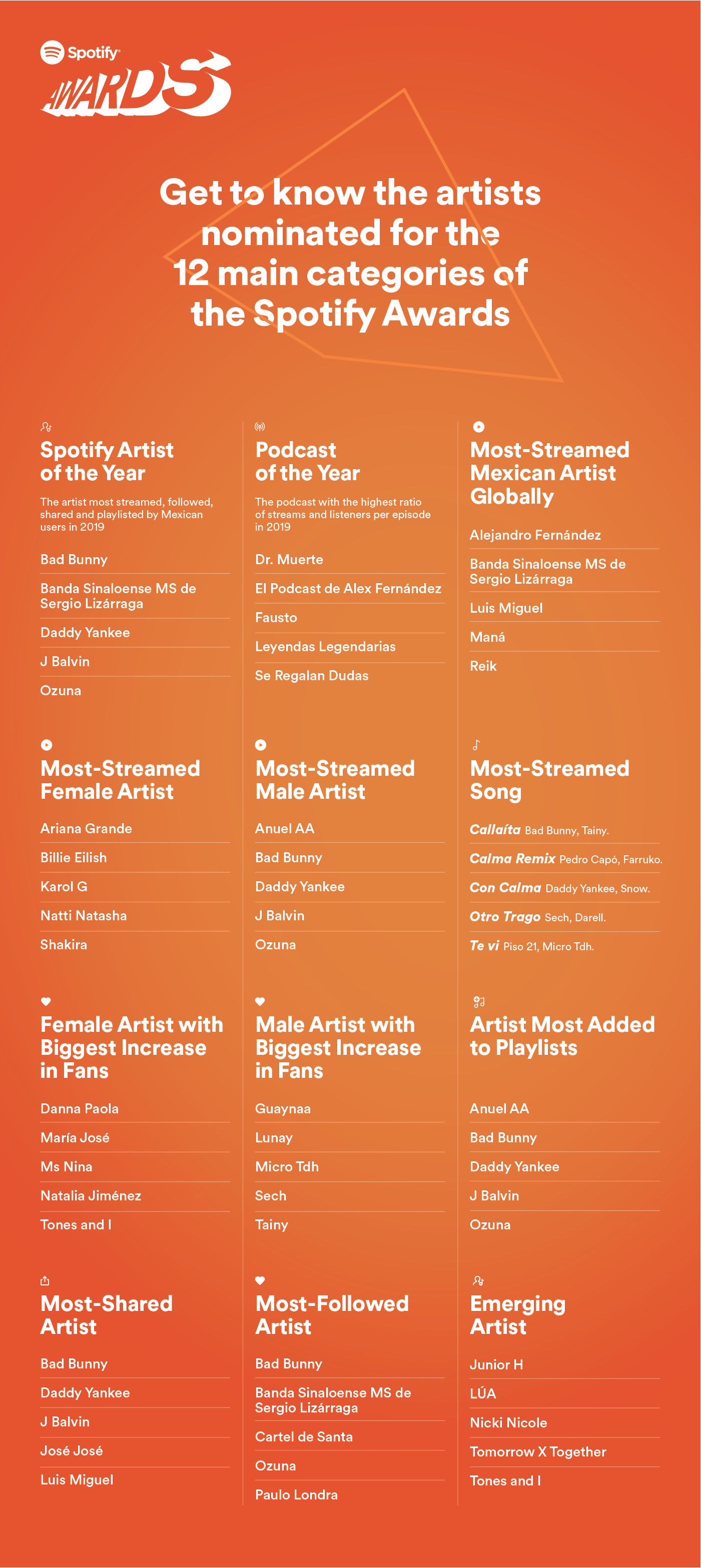
The first ever Spotify Awards are just a few weeks away, and the countdown is on. The event, being held in Mexico City on March 5, is an award show based entirely on user-generated data from our listeners in Mexico.* So your plays, patterns, and habits not only count, but they’re going to determine the award categories, finalists, and winners.

The Spotify Awards are a true reflection of what you—the fans in Mexico—are listening to. So without further ado, meet the finalists for the 12 main Spotify Awards categories.

There will be 44 more categories in total shared on social media and the green carpet, in addition to the twelve above that will be broadcast. So tune into TNT if you are in Latin America or Telemundo and Universo if you are in the United States, visit the official site to learn more about the rest of the categories, and stream the artists from the Spotify Awards hub.

* Spotify Awards data from Mexican users with the exception of “Most streamed Mexican artist outside of Mexico”

Conoce a los finalistas de los Spotify Awards 2020

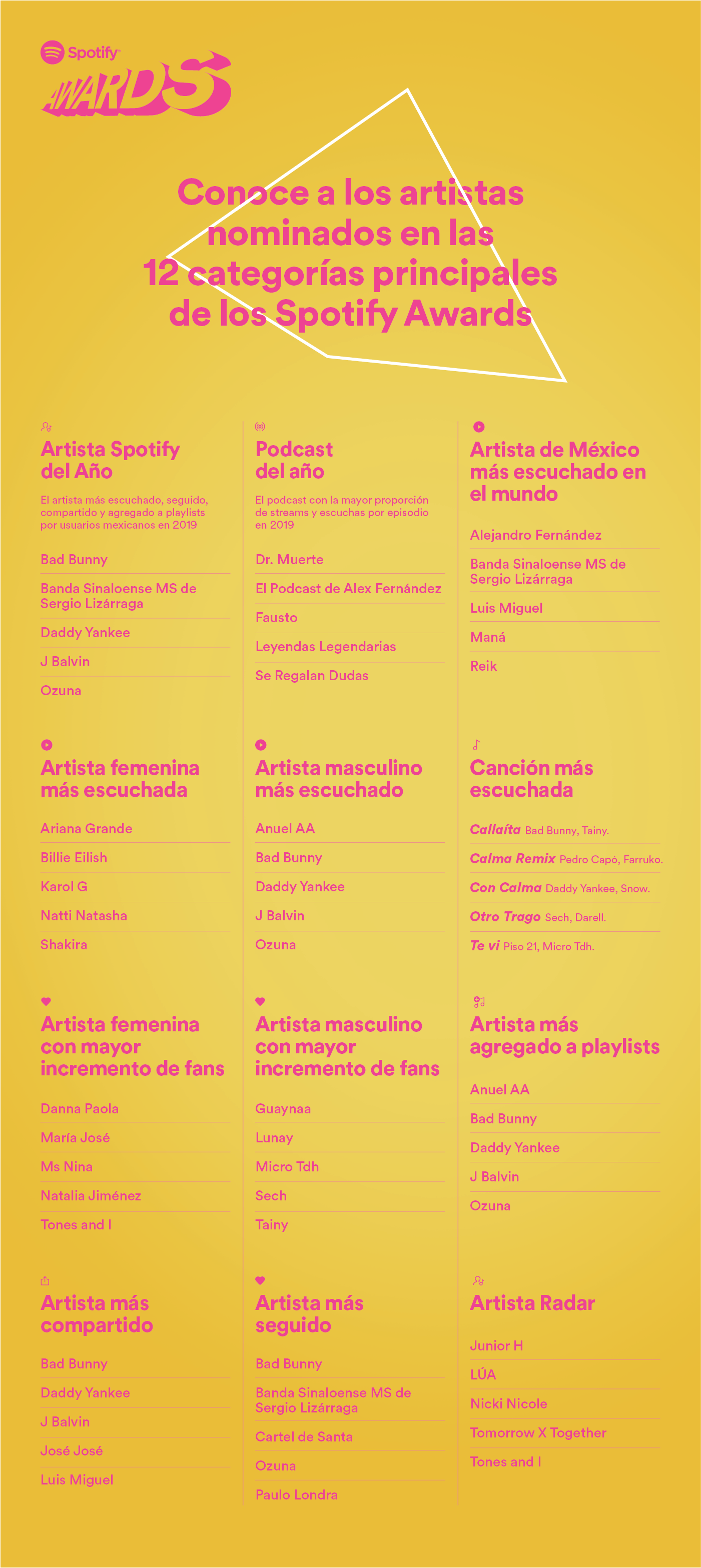
Los primeros Spotify Awards están a tan sólo unas semanas de llegar y la cuenta regresiva ya empezó, el evento se llevará a cabo en la Ciudad de México el próximo 5 de marzo. Estos premios están basados cien por ciento en la data de escucha de nuestros usuarios en México*. Así que tus plays, patrones y hábitos de escucha no solo cuentan, sino que van a determinar las categorías, finalistas y ganadores de los premios. 

Los Spotify Awards son el verdadero reflejo de lo que ustedes, fans en México, están escuchando. Así que, sin más preámbulo, conoce a los 12 finalistas de las categorías principales de los Spotify Awards. 

Habrá más de 44 categorías en total, las cuales serán entregadas en redes sociales y en la Alfombra Verde, 12 de estas se transmitirán en vivo. Así que sintoniza la señal de TNT si estás en Latinoamérica o Telemundo y Universo si estás en Estados Unidos, visita el sitio oficial para conocer con más detalle las categorías que se van a premiar, y escuchar a los artistas finalistas en el espacio dedicado a Spotify Awards


*La data para los Spotify Awards corresponde a usuarios mexicanos con excepción del “Artista de México más escuchado en el mundo”.

El ícono del reggaetón J Balvin cuenta su historia en el nuevo podcast original de Spotify ‘Made in Medellín’

J Balvin no solo es uno de los grandes nombres del reggaetón —es uno de los grandes nombres de la música en la actualidad, punto. ¿Qué tan grande? Pues tan grande como el cuarto artista más escuchado en el mundo: 58 millones de oyentes en Spotify cada mes. En el verano de 2018, los streams de sus fans lo llevaron a un nivel que muy pocos artistas alcanzan —ser el artista número uno en Spotify—. Ahora sus seguidores pueden estar más cerca del reggaetonero en Made in Medellín, el nuevo podcast original de Spotify.

La serie de seis episodios cuenta la historia de J Balvin, que nació como José Álvaro Osorio Balvin, siguiendo su sueño de convertirse en cantante y alcanzar la fama mundial hasta los todos los retos que tuvo que afrontar. Narrado por el mismísimo J Balvin, y con historias de sus amigos y familiares más cercanos, el podcast ofrece una mirada íntima a la vida del artista.

Antes de sintonizar el podcast, mira lo que él y sus seres queridos tienen que decir sobre su viaje por las siguientes citas.

Spotify Premium Duo Plan Now Available for Spotify Listeners in 14 More Countries

It’s happened to us all. You’re streaming mint and grinding through work at your office when, all of a sudden, the music stops. You click open Spotify to see that your significant other, who’s at home, decided to queue up a guilty-pleasures playlist on the smart speaker to sing along to while prepping dinner. Good news, though, for our users in a number of* Latin American countries: The pilot of Spotify Premium Duo, our two-person subscription plan for couples living under one roof that eliminates the difficulties of sharing an account or devices, will be available in 14 additional markets starting September 4.**

Spotify Premium Duo was created for couples who reside at the same address—and it costs significantly less than having two Premium accounts. On top of that, new users who sign up for a Premium Duo plan get the first three months free.

Best of all, Spotify Premium Duo isn’t just for adding a second user—this plan also unlocks several new perks for your family. In addition to each person having a Premium account (and the personalized experience that comes with it), users get:

  • Duo Mix, an automatically updated playlist that combines the music you and your significant other enjoy together—so domestic disputes over who should DJ are likely to be kept to a minimum.
  • The ability to share your playlist library with each other, with just a tap or click.***
  • An easy interface for managing your accounts, settings, and home device setup.

If you already have a Premium plan and want to add your partner by upgrading to Premium Duo, all you have to do is click here to visit your Account page and follow a few quick, easy steps to change your subscription. Keep in mind that the Premium Duo plan requires that both users reside at the same address.

That’s all it takes to start letting the music and podcasts play—with no unwanted interruptions caused by your significant other commandeering your Spotify account for a dinner-prep karaoke session.

 *Offer available in Denmark, Ireland, Poland, Argentina, Bolivia, Chile, Colombia, Costa Rica, Dominican Republic, Ecuador, El Salvador, Guatemala, Honduras, Mexico, Nicaragua, Panama, Paraguay, Peru, and Uruguay.
 **Update October 7, 2019: Spotify Premium Duo is now available in Brazil.
Update March 3, 2020: Spotify Premium Duo is now available in Canada, France, and Japan. New eligible users who sign up for a Premium Duo plan can get the first month free.

***This feature is evolving and will be available in the coming months.

Los 50 de Jenni Brings New Look at the Life of Latin Music Legend Jenni Rivera

Though hit singer-songwriter Jenni Rivera is no longer with us, her impact on Latin music continues to ripple through the genre. To honor her legacy on what would have been her 50th birthday, our Spotify Studios team created Los 50 de Jenni. The exclusive cover story series featured on La Brava includes never-before-seen footage and three distinct versions—banda (main), mariachi, and pop—of an all new, previously unheard track from Rivera herself, “Aparentemente Bien.”

Los 50 de Jenni invites fans to take a seat at the table as Jenni’s family comes together to laugh, cry, and muse on the legacy, tenacity, and spirit that was Jenni Rivera. The exclusive video series, broken down into three “meals,” is available on Spotify beginning July 2. Check out sneak peeks of each of the meals below.

Desayuno (July 2)

“Mis padres, mis hermanos me enseñaron a luchar, a ser fuerte. A querer conquistar. De todo lo que he conquistado, lo más lindo que puedo decir que he tenido es tener un público como el que tengo que me quiere – and I love you guys very much,” opens Rivera in a clip from an event at her alma mater, Long Beach City College. 

In Desayuno (breakfast), we join Doña Rosa and Don Pedro (Jenni’s parents) and Jenni’s siblings (Rosie, Juan, and Lupillo) for breakfast. Doña Rosa sets the table for the family to come together and reflect on Jenni’s incredible balancing act of being La Diva and a mother.

Dinner (July 3)

Three of Jenni’s children (Chiquis, Jenicka, and Johnny) sit down with their aunt and uncle to hear stories of their mother and how the family learned of Jenni’s first pregnancy.

“I love you daughter. I love you for my granddaughter. And, thank you for being a blessing in my life and thank you for bringing another blessing into my life. I love you, I adore you,” says Rivera in a video taken at Chiquis’ baby shower. “It’d be great if my granddaughter looked like me,” she laughs. “All my kids look like me.

 Rivera’s brother and sister go on to share more stories of the late singer in the way only siblings can.

Feliz Cumpleaños, Jenni! (July 4)

The series culminates in the celebration of a life that impacted so many. Rivera’s music, smile, and manner changed the face of Latin music forever. And, even though she may be gone, new music could still be on the horizon.

Le doy gracias a Dios por una mujer tan divertida que, aunque estabas en el peor momento de tu vida, encontramos una forma de hacerte reír – so, thank you, God, for Jenni,” says Rosie, Rivera’s sister, when toasting to the late singer.

Though Rivera died in a plane crash in 2012, her music continues to move us all. With this latest discovery, fans young and old can enjoy new sounds from the late artist, starting with “Aparentemente Bien,” available now on Spotify.


Spotify presenta un podcast original sobre cultura geek: NRDWARE

La cultura pop es un universo en constante expansión. Por eso Spotify presenta NRDWARE, una podcast original que es una oda a todo lo geek y una guía para explorar las novedades en  videojuegos, cine y series, cómics, juegos de mesa, juguetes coleccionables, comics y más.

Para esta producción original, Spotify reúne a cuatro amigos, pioneros en los ámbitos de gaming y tecnología, Lorenzo “Renzo” Grajales, Miguel “Asher” Sandoval, Claudio Quiroz y Mariano “Punisher” Latapí. 

Los cuatro nerds regresan con una cobertura experta del evento que los reunió como amigos hace una década: la convención de videojuegos E3 en Los Ángeles, antes de viajar al parque temático de Star Wars Galaxy’s Edge. 

Hablamos con sus conductores sobre cómo ha evolucionado la cultura geek en la última década, cómo han cambiado sus hábitos de consumo de medios y qué se siente compartir una vez más micrófonos para un podcast.  

¿Cuál es su historia de origen? 

Lorenzo: “Nosotros grabamos podcast antes de que fuera mainstream hace una década. Después todos hemos hablado sobre videojuegos y cultura geek en muchos medios y formatos. Yo diría que hemos conocido la industria de arriba a abajo, como consumidores y como expertos.”

Asher: “En realidad, nuestro producto más exitoso de esa era del internet fueron los especiales de juegos como Metal Gear. Casi me daría pena admitir cuántas horas horas jugamos en línea en la noches Modern Warfare.” 

Mariano: “No puedo describir el carrusel de emociones que ha sido volver a juntarnos después de tanto tiempo. Platicar de lo que más nos gusta es un verdadero placer.” 

¿Cómo definirían NRDWARE?

Claudio: “Es un espacio para hablar de lo que nos apasiona:  videojuegos, series, cine, cómics, juguetes. Habrá invitados cuando el tema lo amerite pero en general estaremos estos cuatro nerds de confianza.”

¿Cómo ha cambiado la cultura geek en una década desde que se conocieron? 

Mariano:La cultura geek ahora es el mainstream. Hoy el inadaptado es el que no ve Game of Thrones o no juega FIFA. Todos somos parte: no importa si son videojuegos, comics o Harry Potter; es una cultura que llegó para quedarse.”

Asher: “Yo diría que el cambio más impactante es el streaming. De hecho todavía no procesamos bien lo que está pasando. Parece inverosímil pensar que hace apenas diez años no existía Spotify o Netflix… ¿cómo pasábamos el tiempo?” 

Mariano: “Por si fuera poco, el streaming y la demanda de contenido ha generado una proliferación de plataformas, productos y medios especializados en transmitir en tiempo real. Nosotros somos los viejitos que fuimos educados por las revistas y nos tocó la transición.” 

Mariano: “Hay un estigma que apunta a que el nerd no es social, pero yo creo que de los “monstruos” más sociales son los gamers, los fans de series, los entusiastas de juegos de mesa.”  

Claudio: “Hoy los fans tienen una forma muy fácil de sentir que pertenecen a una cultura y encontrar un punto de encuentro, ya sea una serie o un juego. Ahora se siente más el pulso de la cultura nerd. Todas las semanas hay algo que vale la pena.” 

¿Cómo ha cambiado su consumo de medios en estos diez años?

Lorenzo: “Jugábamos más. Muchísimas horas a la semana. Ahora lo seguimos haciendo pero somos más quisquillosos con el uso de nuestro tiempo.”

 ¿Qué ha significado esto para nosotros en el plano personal?

Asher: “El cambio también fue brutal. Espacios como los foros y plataformas sociales, donde todos encontramos nuestra voz, eran como una segunda vida pero hoy no se percibe como algo distinto del mundo real. Es parte de una misma realidad.” 

¿Qué se siente estar otra vez los cuatro haciendo un podcast? 

Mariano: “Antes todo era mucho más casero: una consola y micrófonos de segunda mano, producir al mismo tiempo que hablábamos. De hecho lo hicimos en vivo durante mucho tiempo… luego nos dimos cuenta que no tenía sentido y valía la pena entregar algo más pulido.” 

Claudio: “Queremos que la comunidad que lo escuche esté contenta y que vea a NRDWARE como un espacio en el que hablamos de fan a fan, tanto nuestros seguidores como una nueva audiencia a la que queremos llegar.”  

Escucha NRDWARE aquí.

How Trap Met Corrido: The Fusion Genre Taking Over Mexico

One thing is certain in music this year: trap is everywhere. The hip-hop movement, which started in Atlanta, has since spawned microgenres around the world. Today, trap spin-offs include everything from the language-specific interpretations of trap en español, deutsch trap and Arabic trap to rhythmically experimental movements, such as trap funk, trap and bass, or even float tank trap. If there were ever a genre representative of how music transcends and influences cultures, it’s this one. Now there’s a new take hitting the airwaves, inspired by life in northern Mexico and along the US-Mexico border: trap corrido.

At first blush, the idea of trap mixed with corrido (Mexico’s accordion-laced regional folk ballads that date back to the 19th century and include “La Cucaracha”) might seem unlikely to work. But for pioneers in the genre such as Alemán, the rapping duo La Plebada, and nuevo corrido band Grupo Codiciado—who recently collaborated with emerging trap star Gera MX— the combination was meant to be.

After all, as the rappers behind La Plebada, Fntxy, and Cozy Cuz point out, if you grew up in Los Mochis, Sinaloa, corrido and hip-hop were everywhere. The 29-year-old Fntxy told For the Record that listening to his grandmother’s corrido ballads was his first musical memory. Corrido is in his blood, but, he said, he couldn’t sing, so he “had to rap.” Fusing the two genres came naturally to the duo. “One day, we recorded with a guitar, the next day with a beat, and the next day we invented a genre that didn’t exist,” Fntxy told us.  

La Plebada

For Grupo Codiciado, based in Tijuana, the decision to combine corrido with trap was much more deliberate. Collaborating with Gera MX gave them the chance to push the creative limits of corrido. Erick Aragón, the band’s 26-year-old lead singer, originally founded Grupo Codiciado because the more traditional corrido groups he was playing in wouldn’t allow him to experiment with the genre. When he found out Gera MX was not only a fan of corrido, but keen to collaborate, he reached out to his fellow Mexican artist. After throwing a few ideas around on Whatsapp, they headed to the studio to record “Ahí Les Va,” a punchy track with a guitar-derived rhythm, and another single that comes out in July.

Right now, there are no hard and fast rules around trap corrido, and there’s a sense of experimentation each time someone puts the two together. What elements will they take from trap? What will they take from corrido? While musically, corrido’s most signature sounds are the use of the accordion and the bajo sexto (a type of 12-string guitar specific to Mexico), it’s also a cultural and lyrical phenomenon rooted in a tradition of telling stories about what young men do on a daily basis—drive around, party, and hang out.

Both trap and corrido are “genres of the street,” says Alemán. As he outlines life in northern Mexico, the rapper, who hails from Cabo San Lucas, Baja California Sur, prefers to combine the two by overlaying trap beats with lyrics that take their cues thematically from corrido. Rather aptly, the music video for his single “Rucón,” features a corrido-inspired aesthetic. Dressed in button-up shirts, tejana hats, and vaquero boots, Aleman raps, “esto es 100% México,” (this is 100 Mexico) over a traditional trap beat.

Alemán

For Grupo Codiciado, the oral history tradition of corrido and its role in building an identity and passing along information to the next generation has been just as important as perfecting the trap beat.When composing, Aragón draws on his experiences with immigration and crossing the U.S.-Mexico border. He said, “As a singer, you have the opportunity to share messages. The next generation, they don’t know, but they can learn from your path.” Navigating the expectations of both genres has been part of the process. However, at least according to La Plebada, the reaction has been enthusiastic, even from those they didn’t expect to like their music.

After their first single, Los Plebes,” dropped, Noisey described trap corrido as “trap para los niños del rancho” (trap for kids from the ranch). Both Fntxy and Cozy Cuz chuckled at this description. “Totally,” they said. “We make music for people from el rancho, and who aren’t from el rancho. It’s very much about the lifestyle of the area: the horses, the roosters, the cows, the beach. To us, the music is almost nostalgic—for the people who no longer live there, and for the people who live this day-to-day. ” As they told For the Record, it’s about paying homage to their roots on the ranch, but in a modern way.

In the mood for more regional trap? Check out Trapperz Mexa for the best and latest coming out of Mexico.